

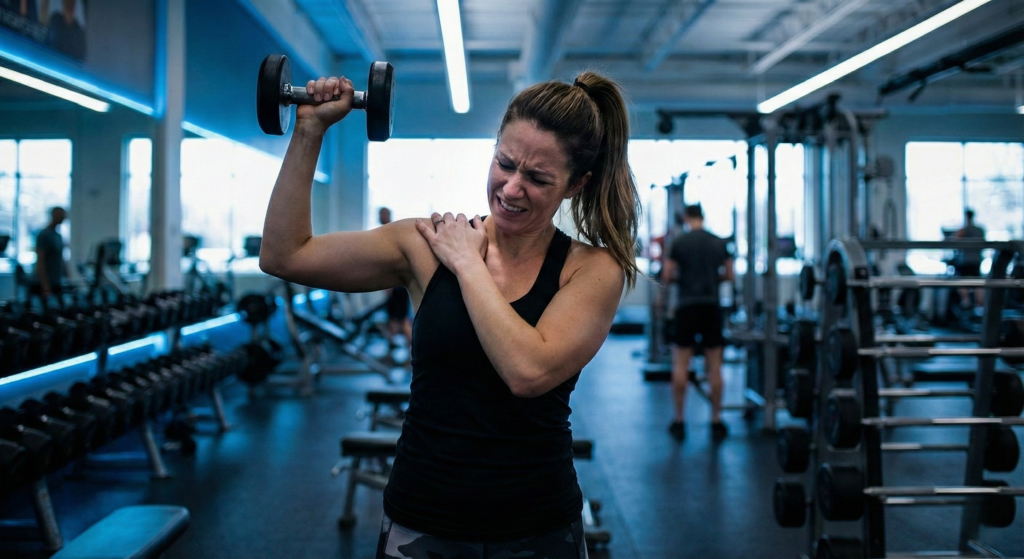
Shoulder pain can sneak up fast — a twinge during a workout or a dull ache that won’t go away when you reach overhead. The most common reason we see this at RX Rehab & Performance in Pacific Beach is irritation of the rotator cuff.
The rotator cuff is a small group of muscles that stabilize your shoulder joint. When they become weak, tired, or overloaded, simple motions can start to hurt. The good news: with the right mix of movement and strength training, most people can get back to lifting, surfing, or throwing without surgery.
1. What the Rotator Cuff Does
Your shoulder is the most mobile joint in the body, but that mobility comes at a cost — it relies on muscles, not bone, to keep it stable. The rotator cuff’s job is to hold the ball of your upper arm bone centered in its socket while you move.
If one or more of these muscles is weak or irritated, the shoulder can move slightly out of rhythm. That small change increases friction and creates inflammation — what people often call impingement.
2. Why Shoulder Pain Starts
Rotator cuff pain rarely happens overnight. It builds from small imbalances, often caused by:
- Overuse or training errors — too much pressing or throwing without enough pulling.
- Poor posture — rounded shoulders or slouched sitting tighten the front of the shoulder.
- Weak scapular stabilizers — the muscles that guide your shoulder blade don’t keep up.
- Sudden load increases — adding weight or reps too fast.
Did you know? Many “rotator cuff tears” seen on MRI are found in people who have no pain at all. What matters most is how strong and coordinated your shoulder is, not what the scan shows.
3. How It Feels
Pain often starts with reaching, lifting overhead, or sleeping on the affected side. You might feel:
- A dull ache deep in the shoulder.
- Sharp pain between 60°–120° of motion (the “painful arc”).
- Weakness when lifting objects or rotating the arm.
Early on, the shoulder may just feel tired; later, stiffness or clicking can appear.
4. How to Check Your Shoulder at Home
If you’re unsure whether your pain involves the rotator cuff, try these gentle checks:
- Painful Arc Test: Raise your arm slowly to the side. Pain mid-range that eases near the top often signals cuff irritation.
- External Rotation Test: Keep your elbow by your side and rotate the arm outward. Weakness or pain suggests the cuff is struggling to stabilize.
Stop if you feel sharp pain — these are just quick guides, not formal diagnoses.
5. The Exercises That Actually Help
Healing the rotator cuff means teaching the shoulder to move smoothly again, not just making the muscles stronger.
Start with pain-free range and focus on control:
- Isometric External Rotation: Stand beside a wall, elbow at your side, and press the back of your hand into the wall without moving. Hold 5 seconds, repeat 10 times.
- Side-Lying External Rotation: Lie on the opposite side with a light weight. Rotate the top arm outward slowly — no jerking.
- Scapular Retraction: With a light resistance band, pull your shoulder blades back and down, keeping neck relaxed.
- Prone Y and T Raises: Lie face-down and lift your arms into a Y or T shape to strengthen the lower traps.
Each move builds balance between the front and back of the shoulder so the joint glides freely again.
6. Common Mistakes to Avoid
- Jumping straight into heavy lifting before pain subsides.
- Overstretching the front of the shoulder — it’s already over-worked.
- Ignoring posture during desk work or long drives.
Small corrections in daily habits often make the biggest difference.
7. How We Treat Rotator Cuff Pain at RX Rehab & Performance
Our clinicians combine hands-on care with targeted exercise to restore healthy shoulder motion:
- Manual therapy and soft-tissue work to reduce tightness.
- Joint mobilization to free up restricted motion.
- Progressive strength training to build resilience.
- Movement re-education so you can press, pull, and lift safely again.
Whether you’re lifting at a gym in La Jolla or paddling out in Bird Rock, our goal is to keep your shoulder strong, pain-free, and built for performance.
8. Keeping Your Shoulders Healthy
Once pain improves, maintenance becomes simple:
- Mix equal parts pushing and pulling exercises.
- Keep your upper back mobile with regular stretching.
- Warm up with light band work before training.
- Don’t ignore small aches — they’re signals to scale, not stop.
Strong shoulders don’t need constant attention — just smart, consistent movement.
FAQ
Q1: Does rotator cuff pain mean a tear?
Not always. Most pain comes from irritation or weakness, not a full tear.
Q2: How long does it take to heal?
Mild cases improve in 4–8 weeks; chronic cases take longer with progressive loading.
Q3: Should I rest my shoulder?
No. Gentle, pain-free movement helps the tissue heal and keeps you from stiffening up.
Q4: What is the best exercise for rotator cuff pain?
Controlled external rotations and scapular retraction drills are safe and effective for most people.
Q5: Can physical therapy or chiropractic help?
Yes. A combined approach that includes manual therapy and exercise has the best long-term results.
Conclusion
Rotator cuff pain doesn’t have to stop you from doing what you love. With the right plan, most people recover fully and come back stronger than before.
At RX Rehab & Performance in Pacific Beach, we focus on long-term solutions — restoring control, strength, and confidence in your movement so you can train, lift, and live without limits.
