

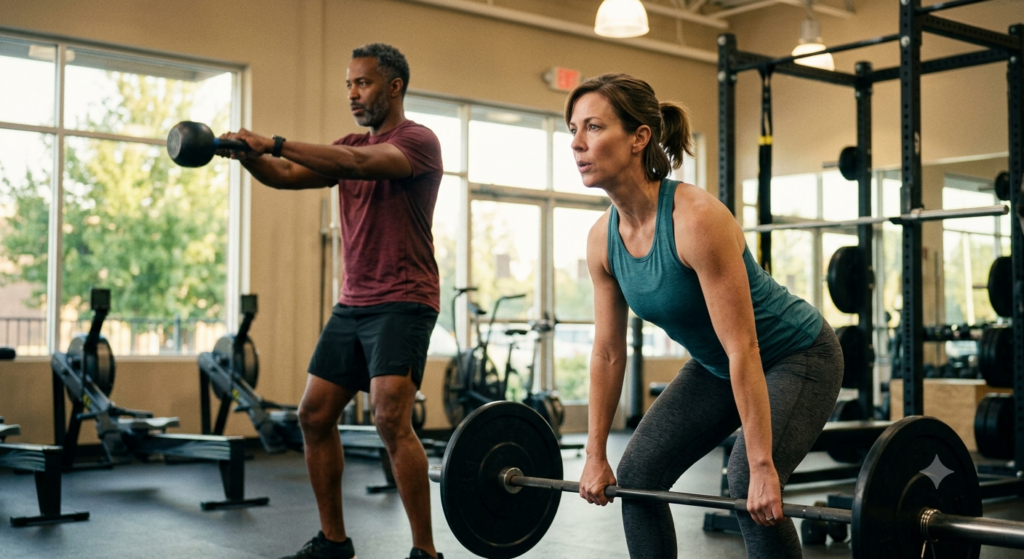
At some point in your late 30s or early 40s, something shifts.
Not dramatically. Not overnight. Just gradually — a recovery that takes a week instead of a few days, an old injury that keeps flaring up, a body that used to bounce back from anything and now doesn’t quite.
And the explanation everyone reaches for is the same one.
“You’re just getting older.”
It’s not wrong exactly. But it’s incomplete in a way that matters — because if age is the whole explanation, there’s nothing to be done about it. You accept it, manage around it, and quietly lower the bar on what you expect from your body.
That’s not what’s actually happening. And it’s not the conclusion you should be drawing.
Here’s what is.
The Real Reason Recovery Feels Different After 35
When active adults in their late 30s and 40s come to Rx Rehab and Performance, they almost always lead with the same sentence: “I don’t know what happened. I used to be able to bounce back from anything.”
And they’re right. Something did happen.
But it wasn’t just biology. It was life.
In your 20s, movement was woven into your daily existence automatically. Sport, training, an active social life — your body was receiving consistent, varied physical input without you having to engineer it. Muscles were being loaded through full ranges of motion. Movement patterns were being reinforced. Recovery was fast because the body was in a constant rhythm of stress and adaptation.
Then life got bigger.
Career advancement. A partner. Children. A mortgage. Responsibilities that expanded to fill every available hour and then some. The schedule that used to have room for four training sessions a week now struggles to fit in two. Movement stopped being automatic and became something you had to carve out time for — and some weeks you did, and a lot of weeks you didn’t.
None of this felt catastrophic at the time. But while life was getting busy, your body was quietly adapting to the new reality.
And adaptation is always a two-way street.
What Happens When Movement Falls Away
The human body is remarkably responsive. It adapts to the demands placed on it — building strength, speed, and resilience when those qualities are trained, and quietly letting them diminish when they’re not needed.
When movement becomes inconsistent — when training goes from four days a week to whenever you can, which slowly becomes not really anymore — certain things start to change underneath the surface.
Muscles that aren’t being consistently loaded begin to underperform. The glutes that used to fire powerfully through a deadlift start to become less responsive. The deep core stabilizers that protected your spine during heavy lifts begin to lose their coordination. The rotator cuff muscles that kept your shoulder healthy through overhead work stop doing their job as reliably.
These aren’t dramatic changes. They happen gradually, quietly, below the threshold of awareness. You don’t notice a muscle stopping firing. You just notice, months later, that something hurts.
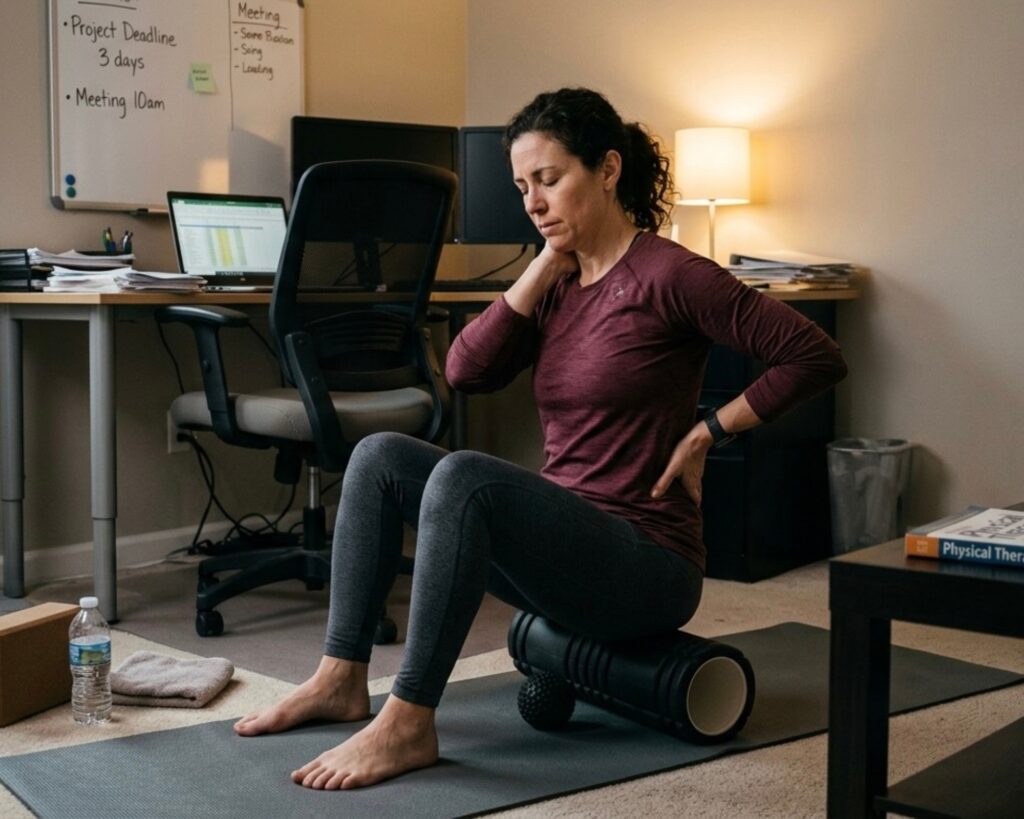
Movement patterns shift. When certain muscles underperform, others pick up the slack. The body is extraordinarily creative about finding workarounds — it will always find a way to complete a movement, even if that way isn’t optimal. A hip that doesn’t extend fully because the glute isn’t firing will compensate through the lower back. A shoulder that lacks rotator cuff stability will compensate through the neck and upper trap. These compensations feel normal because they become normal. But they’re loading structures in ways those structures were never designed to handle.
Old injuries stop fully resolving. That thing you tweaked two years ago — the shoulder, the knee, the back — that you rested for a few weeks and then got back to training on? It probably resolved enough to function. But without a deliberate return-to-performance process, the compensation patterns that developed around it likely stayed. And those patterns are still running, still loading the same tissues unevenly, every single day.
This is the accumulation. Not age — accumulated adaptations. A decade of small adjustments, unaddressed injuries, and movement patterns that quietly reorganized themselves around the gaps in your schedule.
Why This Feels Like Age — But Isn’t
Here’s why the age explanation feels so convincing.
The timing lines up. The changes happen in your 30s and 40s. Biology does shift during these years — hormone levels change, tissue repair takes a little longer, sleep quality often decreases. These are real physiological changes and they do have an effect.
But here’s what the age narrative misses:
The biological changes that come with age affect the rate of recovery. They don’t fundamentally change the capacity to recover.
Your body at 42 is still the same adaptive organism it was at 22. It still responds to progressive loading. It still builds strength and restores function when given the right input. It still has the ability to unlearn compensation patterns and replace them with better ones. The mechanism hasn’t changed — the timeline has shifted, and the starting point is more complex because there’s more to unwind.
The active adults who feel like their body has failed them aren’t experiencing inevitable decline. They’re experiencing the compounded result of a decade of accumulated adaptations — and those adaptations are reversible.
What it takes is the right plan. Not the generic kind. A specific plan built around what has actually accumulated in their specific body, targeting the specific patterns that developed around their specific history of injuries, demands, and gaps.
The Three Things That Actually Drive Recovery Difficulty After 35
Understanding what’s happening is the first step to fixing it. Here are the three real culprits behind why recovery feels harder — none of which are simply “getting older.”
1. Unresolved Compensation Patterns
Every injury you’ve ever had, every period of inactivity, every repetitive demand of work or sport has left a mark on how you move. Not always a painful one — often invisible, just a slight shift in how load is distributed, which muscles are doing the work, how the joints are tracking.
These patterns compound. One compensation changes the loading environment for another structure. That structure adapts. Its adaptation changes the loading for something else. Over time, you have a movement system that has been quietly reorganizing itself around a history it was never given the chance to fully address.
When you try to train hard, travel, play sport, or simply move the way you used to — this reorganized system gets exposed. The structures bearing load they weren’t designed to carry get irritated. Recovery takes longer because the system has to recover from both the training demand and the inefficiency of the compensation pattern underneath it.
2. Inconsistent Loading History
The body maintains what it uses. A consistent training history — even an imperfect one — keeps the neuromuscular system responsive, the tissues loaded, and the movement patterns intact.
An inconsistent history does the opposite. Periods of high demand followed by periods of inactivity create a cycle where the body is repeatedly adapting to different realities. It never fully consolidates the adaptations from a training block before that block ends. It loses capacity during the inactive periods faster than it gains it back during the active ones.
Over a decade, this creates a body that is simultaneously overtrained in certain patterns and undertrained in others — and that combination is exactly what produces the feeling of being perpetually beat up, never fully recovered, always one session away from something flaring up.
3. The Absence of a Bridge Back
After every injury, every setback, every period of reduced activity — there should be a deliberate bridge back. A progressive process that reintroduces the demands of training and sport in a way that allows the body to adapt, the compensation patterns to be addressed, and confidence in the body to be rebuilt.
Most active adults never get that bridge. They rest until the pain goes away and then go back to what they were doing. Or they do a round of PT, get some relief, and are discharged before they’ve completed the return-to-performance process.
The result is a body that has been back to full training multiple times without ever being fully prepared for it. The unresolved patterns from each setback stack on top of each other. And the gap between how the body performs and how the person expects it to perform grows wider every year.
What “Reorganized” Actually Means
Here’s the most important thing to understand about everything described above.
Reorganized doesn’t mean broken. It doesn’t mean permanent. And it doesn’t mean the trajectory is fixed.
The body adapts in the direction of the input it receives. It always has. The same mechanism that allowed these compensation patterns to develop over years of accumulated life is the same mechanism that allows them to be identified, addressed, and replaced with something better.
It takes the right input. Applied in the right sequence. With enough consistency to actually produce durable change rather than temporary relief.
That’s not a vague promise. That’s how the physiology works — at 35, at 45, at 55.

What This Means for You
If you’re in your late 30s or 40s and recovery has started to feel like a different thing than it used to — longer, less predictable, never quite complete — there’s a real explanation for that. And it’s not that your body has given up on you.
It’s that your body has a lot more to unwind than it did ten years ago. And it needs a plan designed for where it actually is — not a generic protocol, not another round of treatment that stops when the pain does, but a complete return-to-performance process that addresses the full picture of what has accumulated.
At Rx Rehab and Performance in Pacific Beach, we work with active adults across San Diego — from Clairemont and Mission Hills to La Jolla and Point Loma — who are done accepting a body that feels like it’s working against them.
We start where you actually are. We build toward where you actually want to go. And we don’t stop at symptom relief.
Start With a Conversation
The first step is a free 20-minute Discovery Call.
No front desk. No intake forms. Just a direct conversation about your history, what’s been building, and whether we’re the right fit to help you unwind it.
If we are, we’ll bring you in for a complimentary 30-minute Discovery Visit — a comprehensive movement screen where we identify what’s actually driving the problem, not just where it hurts.
Your body isn’t failing you. It’s waiting for the right plan.
Book Your Free Discovery Call → RXRP call calendar
Dr. Albert is the Owner and Head Physician at Rx Rehab and Performance, a rehab and performance clinic located in Pacific Beach, San Diego, CA. Rx Rehab and Performance serves active adults throughout San Diego including Clairemont, Mission Hills, La Jolla, Point Loma, Bay Park, Mission Valley, Kearny Mesa, and surrounding neighborhoods.
CORRECT | ADVANCE | OPTIMIZE
