


There’s a sentence I hear more than almost any other in this clinic.
Not about pain levels. Not about diagnosis. Not about what the MRI showed.
It’s this:
“I used to be the athletic one.”
Past tense. Quiet. Said almost matter-of-factly — the way you’d describe something that was true a long time ago, like a job you used to have or a city you used to live in.
Not with anger. Not with self-pity. Just with the settled acceptance of someone who has already done the work of making peace with a loss they never fully named.
That sentence tells me more about a patient than almost anything else. Because it means the injury isn’t just physical anymore. It’s become identity.
And that changes everything about what recovery has to address.
The Injury That Doesn’t Show on a Scan
When active adults in their late 30s and 40s come to Rx Rehab and Performance, they almost always arrive with a clear physical complaint. A shoulder that won’t cooperate. A knee that keeps flaring up. A back that has been the obstacle for so long it has its own permanent place in every plan they make.
But underneath the physical complaint — beneath the pain scores and the movement limitations and the history of treatments that helped a little but never all the way — there’s almost always something else.
A slow, quiet erosion of athletic identity.
It doesn’t happen overnight. It happens in the small decisions that accumulate over months and years.
The first time you decline a pickup game because you’re not sure your knee can handle it. The first time you modify a workout around something that used to be automatic. The first time you stop signing up for the race, the league, the trip — not because you’ve decided you don’t want it, but because somewhere along the way you stopped believing your body could be trusted to deliver it.
Each decision feels reasonable in the moment. Protective. Practical.
But over time, the accumulated weight of all those decisions adds up to something larger. The life you’re living starts to look meaningfully different from the one you used to imagine for yourself. The physical things you used to reach for — the goals, the events, the casual athleticism that was just part of who you were — have quietly moved to a different category.
The category of things that used to be true.
Ryan’s Story
Ryan was 44 when he first came to see us.
Former CrossFit athlete. Recreational basketball. The person his friends called when they needed someone who was always up for something physical.
His 30s had been good — demanding, full, the kind of decade that builds a life — but the training had become inconsistent. A promotion. Two kids. A schedule that left no real margin. He’d kept up with it when he could, which was less and less often.
His shoulder had been building for two years. Not one injury — just a gradual accumulation of things that never got addressed, loaded on top of a body that hadn’t had consistent maintenance in years. Until one morning he reached for something on a high shelf and couldn’t.
He did PT. Got some relief. Was told he was fine.
He wasn’t fine. He just wasn’t in acute pain anymore.
He stopped mentioning to people that he used to train. It felt dishonest. Like claiming credit for something that belonged to a different version of himself.
When Ryan came to Rx Rehab and Performance, I asked him what he wanted to get back to.
He paused for a moment.
“I just want to feel like myself again.”
Not a performance metric. Not a specific lift or a race time. Just himself — the version of himself that moved without hesitation, that showed up to physical things without calculating risk first, that didn’t have to think about his shoulder every time he reached for something.
That answer shaped everything about how we built his program.
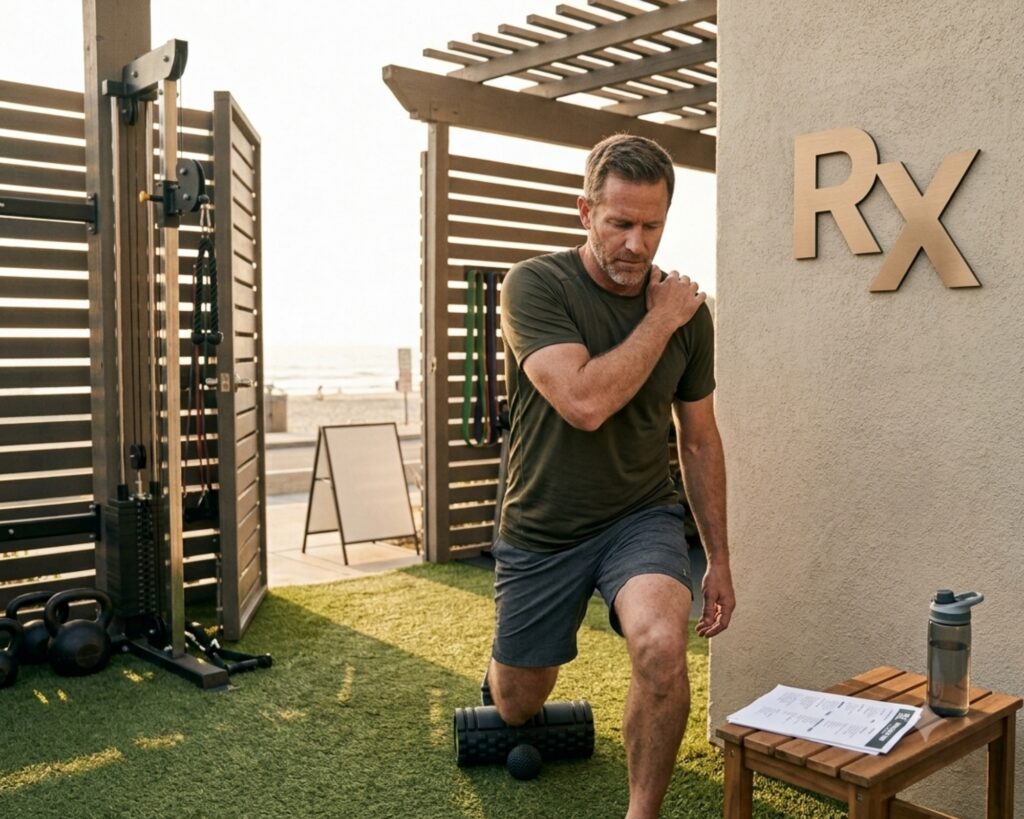
Why “Just Getting Back to the Gym” Isn’t the Real Goal
Here’s something that becomes clear quickly when you work with active adults who have lost their athletic identity:
The physical goal is rarely the deepest goal.
Ryan didn’t just want his shoulder to stop hurting. He wanted to press overhead again — but that wasn’t really it either. He wanted to walk into a gym and know what he was doing. He wanted to show up to a basketball court without pre-gaming it in his head. He wanted to stop doing the quiet mental calculation — “can my body handle this?” — before every physical decision.
He wanted to trust his body again.
That’s the real goal. And it’s one that a program built only around pain reduction will never fully reach.
This is why the intake process at Rx Rehab and Performance starts with questions that don’t seem to be about the injury. What does your life look like when your body isn’t the obstacle? What’s the first thing you’d do if the limitation weren’t there? What have you stopped letting yourself want because it felt dishonest to want it?
Those questions aren’t soft. They’re the most clinically relevant information we can collect — because the answers define what success actually looks like for this specific person. And a plan that doesn’t know what success looks like can’t reliably produce it.
The Identity Gap — And Why It Matters Clinically
The loss of athletic identity isn’t just an emotional experience. It has direct clinical implications for recovery.
Research on pain neuroscience is clear that the brain’s perception of identity and capability directly influences pain sensitivity and movement confidence. When someone has spent months or years operating from the belief that their body can’t be trusted — modifying, avoiding, protecting — the nervous system begins to reflect that belief. Movement that feels threatening produces guarding. Guarding produces compensation. Compensation produces more pain.
It becomes a self-reinforcing cycle. And it doesn’t break just because the structural issue is treated.
This is why patients can complete a standard rehabilitation program, be told their injury has resolved, and still feel like something is missing. The tissue healed. The compensation patterns were partially addressed. But the identity gap — the gulf between who they used to be physically and who they believe themselves to be now — was never closed.
Closing that gap is not a motivational exercise. It’s a clinical one.
It requires progressive exposure to the movements and demands that the nervous system has classified as threatening. It requires building a new library of evidence — through actual reps, actual loads, actual performance — that the body can be trusted again. It requires a program long enough and specific enough to get all the way to the other side, not just to the point where the pain is manageable.
What Getting It Back Actually Looks Like
Thirteen weeks into his program, Ryan was back in the gym.
Pressing overhead. Playing basketball on weekends. Moving without the mental calculation he’d been running before every physical decision for two years.
He texted after his first full session back. Two words.
“I’m back.”
That text wasn’t about his shoulder. It was about his identity. About the version of himself that had gone quiet — that had stopped coming up in conversations, stopped being part of how he described himself — coming back online.
That’s what a complete return to performance looks like when it goes all the way.
Not just pain-free. Trustworthy. Capable. Fully inhabited.
The Pattern Behind Ryan’s Story
Ryan’s details are specific to him. But the pattern is one we see constantly.
Active adults in San Diego — in La Jolla and Mission Hills, in Point Loma and Bay Park, in Clairemont and Kearny Mesa — who were the athletic ones. Who built their sense of self partly around their physical capability. And who, over the course of a decade of life getting bigger and injuries not fully resolving, quietly stepped back from that part of their identity without ever making a conscious decision to do so.
They didn’t decide to stop being athletes. They just gradually stopped acting like one. And eventually the gap between who they were and who they’d become felt too wide to bridge.
It isn’t.
The gap is almost always smaller than it feels at the moment you’re most discouraged about it. The body’s capacity to adapt, rebuild, and return is more intact than years of accumulated frustration make it seem.
What it needs is a plan that takes it seriously. That starts with the real goal — not just the symptom — and builds every week of programming in its direction.

Is This Your Story?
If you recognized yourself somewhere in this — if “I used to be the athletic one” is a sentence that has crossed your mind, spoken or unspoken — I want you to know something.
That version of you isn’t gone. It’s just been waiting for a plan good enough to bring it back.
At Rx Rehab and Performance in Pacific Beach, the first conversation we have isn’t about your injury. It’s about who you are when your body isn’t the obstacle — and what it’s going to take to get you back there.
Start With a Conversation
We offer a complimentary 20-minute Discovery Call — a direct conversation about your history, your goals, and whether we’re the right fit to close the gap.
If we are, we’ll bring you in for a complimentary 30-minute Discovery Visit — a real movement screen where we identify root causes and start building the map from where you are to where you want to go.
Not halfway back. All the way.
Dr. Albert is the Owner and Head Physician at Rx Rehab and Performance, a rehab and performance clinic located in Pacific Beach, San Diego, CA. Rx Rehab and Performance serves active adults throughout San Diego including La Jolla, Mission Hills, Point Loma, Bay Park, Clairemont, Kearny Mesa, Mission Valley, and surrounding neighborhoods.
CORRECT | ADVANCE | OPTIMIZE
