


There’s a version of this conversation I’ve had hundreds of times.
Someone sits across from me and describes, in detail, exactly what’s been going on. The injury that started it. The treatment that helped a little. The gradual adjustments they made. The things they’ve stopped doing. The version of themselves they’re trying to get back to.
They understand the problem. Clearly. Articulately. Sometimes better than patients who have been in active treatment for months.
And then I ask when they’d like to start.
And they say someday.
Not in those words, usually. It sounds more like: “Once things settle down at work.” “After the summer.” “When the kids are back in school.” “When it gets bad enough that I have no choice.”
Someday. Every time.
I’m not going to pretend that’s not a real answer. Life is full. Schedules are demanding. The idea of adding one more thing — even something that would fix the problem — genuinely feels like too much sometimes.
But I want to be honest with you about what someday actually costs. Because most people have never done that math.
The Real Cost of Waiting
Every month you wait to address the root cause of a movement problem is a month that the compensation patterns driving it get more ingrained.
This isn’t a scare tactic. It’s how the neuromuscular system works.
The brain learns through repetition. Every time you move with a compensation pattern — every squat, every walk, every workout, every morning you get out of bed — that pattern gets reinforced. The neural pathway gets stronger. The body gets better and better at moving inefficiently.
This means that a compensation pattern that takes eight weeks to address today might take twelve weeks to address six months from now. The same problem, given more time to solidify, requires more work to reverse.
Meanwhile, the structures being overloaded by that pattern continue to accumulate stress. The tissue that keeps getting irritated keeps getting irritated. The joint that keeps being loaded unevenly keeps wearing unevenly. The injury that “almost healed” stays almost healed — close enough that you can function, far enough from fully resolved that it keeps showing up every time you push.
Waiting doesn’t pause the problem. It compounds it.
What “When Things Settle Down” Actually Means
Here’s the honest truth about the perfect time to start.
It doesn’t exist.
Work doesn’t settle down. The schedule doesn’t open up. The kids don’t become less demanding. The responsibilities don’t shrink to make room for the thing you’ve been putting off.
The people who wait for conditions to be right before they invest in their health are the same people, five years later, who are dealing with a more complex version of the same problem — with a body that has adapted more deeply to the compensations, an identity that has moved further from the athletic version of themselves they’re trying to reclaim, and a gap between where they are and where they want to be that is genuinely wider than it needed to be.
That’s not inevitable. It’s a choice — usually made passively, by default, through the accumulation of somedays.
The active adults who break that pattern don’t do it because conditions became perfect. They do it because they decided that the cost of waiting was higher than the cost of starting.
That’s a decision, not a circumstance.
The Three Versions of Someday
In practice, someday shows up in three specific forms. All of them feel reasonable. None of them are actually waiting for the right time — they’re waiting for a feeling of permission that doesn’t come from outside.
“When the pain gets bad enough”
This is the most common version. The idea that the current level of limitation isn’t quite bad enough to justify the time, effort, and investment of a proper rehabilitation program.
The problem with this threshold is that it keeps moving.
When the pain is a three, you wait until it’s a six. When it’s a six, you’ve adapted to it enough that it doesn’t feel as urgent as it did when it first arrived. The body is extraordinary at normalizing discomfort — at reorganizing daily life around it so efficiently that it stops feeling like a crisis and starts feeling like just the way things are.
By the time the pain is bad enough to force action, the underlying problem has usually gotten significantly more complex — and the road back is longer than it would have been at the three.
Don’t wait for bad enough. Start at “this is limiting the life I want to live.”
“When I have more time”
Time doesn’t appear. It’s allocated.
The people who say they’ll start when they have more time are, in almost every case, the same people who never have more time — because time is a function of priority, not of schedule.
When something becomes genuinely important enough, it gets scheduled. Not squeezed in — scheduled, protected, treated as non-negotiable. The same way a work commitment or a child’s event gets protected.
Your physical health — your ability to move, perform, and live in your body the way you want to — is worth that protection. The question isn’t whether you have time. It’s whether you’ve decided it’s worth making time for.
“When things calm down”
Things don’t calm down. They change shape.
The specific pressures of this season will eventually pass. They’ll be replaced by a different set of pressures. The calendar that feels impossible right now will feel different in three months — but it will still be full, just with different things.
Waiting for calm is waiting for a season that doesn’t come. The people who start in the chaos are the ones who finish. The ones who wait for calm are still waiting.
What Starting Actually Looks Like
One of the biggest misconceptions about beginning a rehabilitation program is the idea that it requires a dramatic restructuring of your life.
It doesn’t.
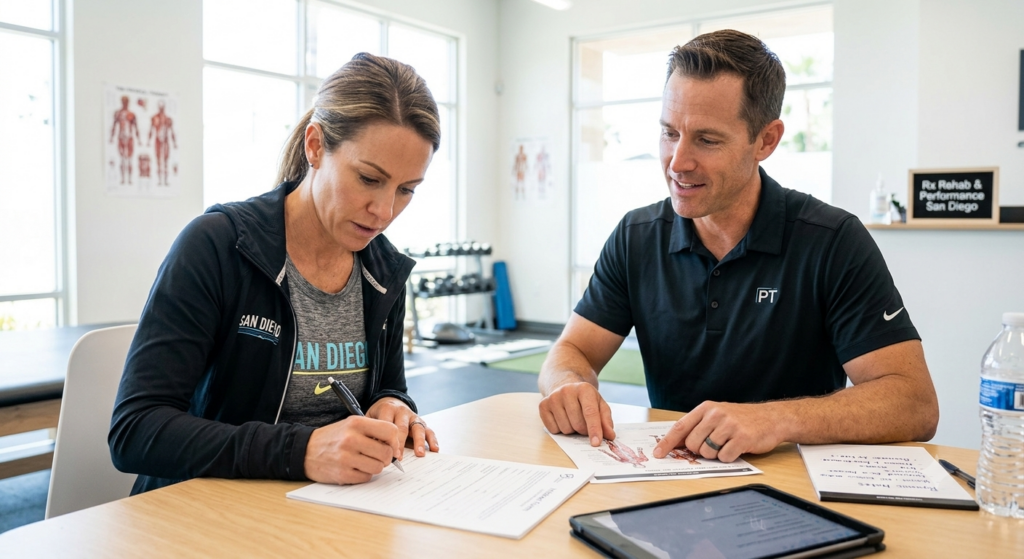
The first step is a 20-minute conversation. That’s it. A Discovery Call where we learn about your history, your goals, and whether RXRP is the right fit for where you want to go.
If it is, we bring you in for a complimentary 30-minute Discovery Visit — a movement screen where we start identifying what’s actually driving the problem. Not where it hurts, but why it keeps hurting.
From there, we build a plan. A real one, designed around your specific situation, your specific goals, and your specific life. Not something that requires you to show up five days a week — something that fits into the schedule you actually have while producing the outcome you actually want.
The investment of time is real. So is the return on it.
Because on the other side of a program built around getting you all the way back — not halfway, not to the point where the pain is manageable, but all the way — is a body you trust again. A life you stop planning around a limitation. The version of yourself you’ve been describing in the past tense.
That’s what’s on the other side of someday.
The Patients Who Don’t Wait
The patients who get the most out of Rx Rehab and Performance aren’t the ones who waited until they had no choice. They’re the ones who decided — while the choice was still theirs — that the cost of waiting was too high.
They’re the people in their late 30s and 40s in San Diego — in Mission Hills and La Jolla, in Clairemont and Point Loma, in Bay Park and Mission Valley — who looked honestly at the trajectory they were on and decided they wanted a different one.
They started before conditions were perfect. They made time before there was extra time. They booked the call before they had every question answered.
And they got all the way back.

The Right Time Is the One You Choose
Nobody is going to hand you a perfect window. The schedule isn’t going to clear itself. The pain isn’t going to reach a threshold that feels objectively bad enough.
The right time is the one you decide is the right time.
If you’ve been reading these words and recognizing yourself — if someday has been your answer for longer than you’d like to admit — this is your prompt.
Not because it’s a sales pitch. Because the version of you that moves without hesitation, that shows up to physical things without calculating risk, that stops describing their athletic life in the past tense — that version of you exists on the other side of a decision you can make today.
We offer a complimentary 20-minute Discovery Call — a direct conversation about where you are, what’s been building, and what a real plan forward looks like.
No front desk. No forms. No obligation.
Just the first step.
Dr. Albert is the Owner and Head Physician at Rx Rehab and Performance, a rehab and performance clinic located in Pacific Beach, San Diego, CA. Rx Rehab and Performance serves active adults throughout San Diego including Mission Hills, La Jolla, Clairemont, Point Loma, Bay Park, Mission Valley, Kearny Mesa, and surrounding neighborhoods.
CORRECT | ADVANCE | OPTIMIZE
