

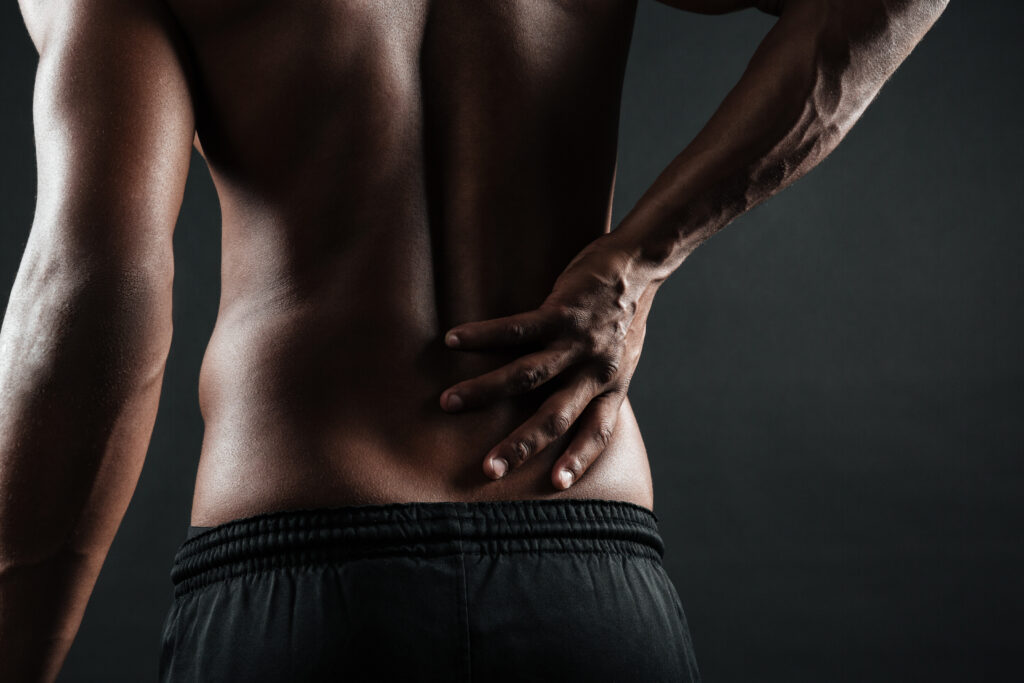
You’re mid-squat or pulling a heavy deadlift when a sharp pinch hits deep in your hip. You rack the bar, shake it off, and try again — same pain, same frustration.
If that sounds familiar, you’re not alone. Hip pain during training is one of the most common reasons lifters and athletes visit RX Rehab & Performance in Pacific Beach.
The problem isn’t the lift itself — it’s how your body is moving under load. Once you adjust the setup and rebuild control, you can usually keep training and stay strong.
1. Why Hips Hurt During Lifting
The hip joint is a deep ball-and-socket design made for power and range. When movement around it becomes unbalanced, tissues start competing for space.
Common causes include:
- Limited hip mobility (especially internal rotation) that leads to pinching at the front.
- Weak glutes or core that allow the femur to glide forward.
- Poor squat depth control — dropping past your mobility instead of into it.
- Load management errors — adding weight or volume too fast.
None of these mean you’ve damaged the joint; they just signal that your body needs new strategies for load sharing.
2. The Myth of “Bad Form”
Many lifters assume pain means their form is wrong. In reality, there’s no single “perfect” squat or deadlift.
Different hip shapes, mobility levels, and training histories all change what safe movement looks like for each person.
The goal isn’t to copy someone else’s technique — it’s to find your best position where the hip feels strong, not pinched.
3. Short-Term Fixes That Keep You Lifting
Instead of stopping training completely, make small adjustments to keep moving while symptoms calm down.
- Widen your stance slightly or turn the toes out 5–10 degrees to open the hip space.
- Control the bottom position — pause just above where pain starts, then come back up.
- Try a high-bar squat or trap-bar deadlift for a more upright torso angle and less hip compression.
- Reduce load temporarily but keep total movement volume similar — strength maintenance comes from consistency, not just max weight.
These tweaks let you train pain-free while you address the real issue: how your hips and core share load.
4. Rebuilding Hip Control and Strength
Once pain starts to fade, focus shifts to retraining movement.
At RX Rehab & Performance, we use drills that build both mobility and stability around the hip joint.
90/90 Hip Rotations — improve rotation control and capsule mobility.
Glute Bridges → Single-Leg Bridges — restore power to the glutes.
Tempo Squats — slow down the descent to teach control through range.
Lateral Step-Downs — train single-leg balance and hip endurance.
These exercises strengthen the muscles that keep the femur centered in the socket, preventing that deep anterior pinch that frustrates so many lifters.
5. When to Get Checked
If your hip pain:
- Lingers for more than a few weeks,
- Limits your depth or power, or
- Radiates into the groin or thigh,
…it’s time for an assessment.
Our team in Pacific Beach looks at how your spine, hips, and core interact under load — not just how the joint looks in isolation.
Most lifters we see from La Jolla, Bird Rock, and Clairemont return to full training within a few weeks once movement control and load progression are dialed in.
6. The Long-Term Game Plan
Strong hips thrive on consistency, variety, and smart loading.
Here’s what keeps them pain-free:
- Mix hip-dominant and knee-dominant lifts weekly.
- Maintain regular mobility work (especially internal rotation).
- Warm up with dynamic movements, not static stretches.
- Gradually increase load and volume — your tissues need time to adapt.
These habits turn short-term fixes into lasting performance gains.
FAQ
Q1: Should I stop squatting if my hip hurts?
A1: Not necessarily. Modify stance or depth and keep moving within a pain-free range.
Q2: What causes hip pinching during squats?
A2: Usually limited mobility or control at the front of the joint — not structural damage.
Q3: Can physical therapy help hip pain from lifting?
A3: Yes. A combination of manual therapy, load modification, and strength retraining gives fast, lasting results.
Q4: How long does hip tendinopathy or impingement take to heal?
A4: Most lifters improve within 4–8 weeks with guided loading and movement corrections.
Q5: Are deep squats bad for your hips?
A5: No — if mobility and control are adequate. Pain signals a need for adjustment, not avoidance.
Conclusion
Hip pain doesn’t have to mean time off or loss of progress.
With small adjustments, smarter load control, and targeted strength work, most lifters return to heavy squats and deadlifts stronger than before.
At RX Rehab & Performance, we help athletes across Pacific Beach and La Jolla lift confidently again by addressing movement mechanics, not just treating pain.
