

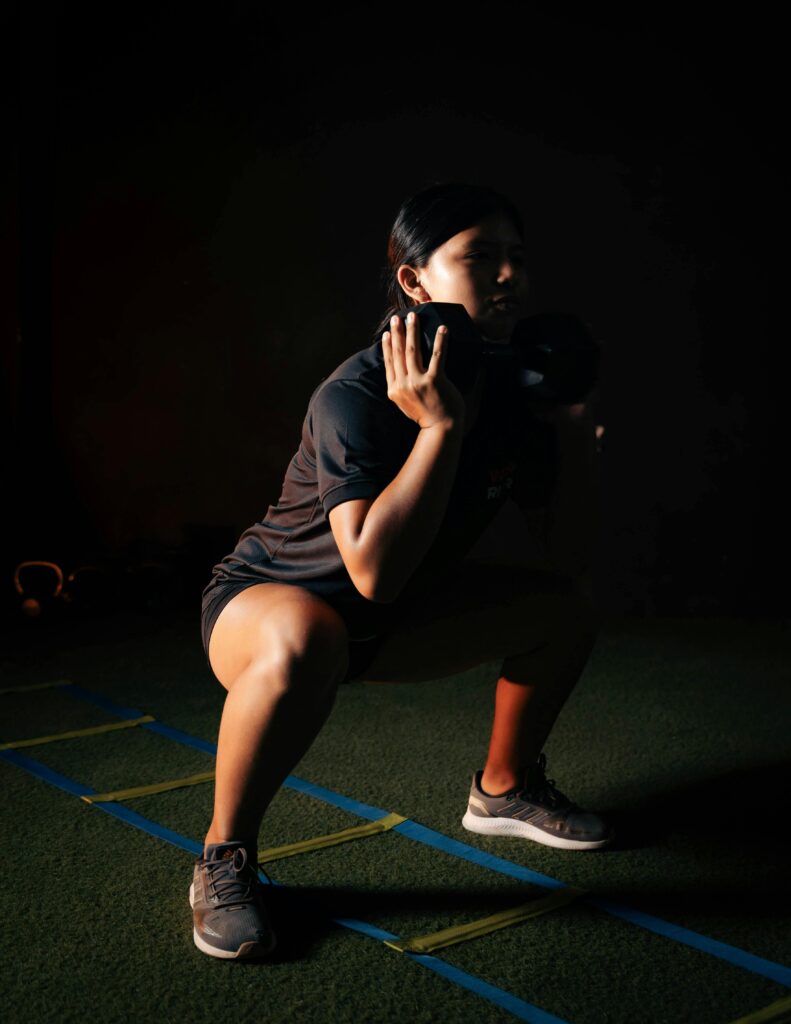
You’re midway through your squat set when that familiar ache shows up at the front of your knee. It’s not sharp enough to stop you — but it’s annoying enough to make you second-guess every rep.
At RX Rehab & Performance in Pacific Beach, we see this all the time — lifters and athletes dealing with knee pain that keeps them from training at full potential.
The good news: it’s rarely something serious. Most of the time, it’s the body’s way of saying the joint needs a small tune-up — better mobility, improved control, or smarter loading.
1. Why Knees Start to Hurt During Squats
Knee pain during squats isn’t always about the knee itself. It’s often a byproduct of how your hips, ankles, and core move together.
When one link in the chain stiffens or loses control, the knee ends up taking more load.
Common contributors include:
- Limited ankle mobility, which forces the knee forward too early.
- Weak or delayed glute activation, shifting pressure to the front of the knee.
- Poor load management — increasing weight or volume too quickly.
- Unbalanced strength between quads and posterior chain.
The result? Extra strain on the patellar tendon and front of the knee, especially at the bottom of the squat.
2. The Role of Mobility
Mobility doesn’t mean endless stretching — it’s about creating enough range of motion to move comfortably through your lift.
Ankle Mobility:
Try elevating your heels slightly with plates or lifters — if your pain decreases, ankle stiffness might be part of the issue.
Adding controlled ankle rocks or calf raises before training can help.
Hip Mobility:
Tight hip flexors or adductors can limit your ability to sit into the squat.
Gentle dynamic warm-ups like 90/90 rotations or deep squat holds can help prepare your hips without overstretching.
Small improvements in mobility can make a big difference in knee comfort.
3. How Technique Influences Pain
Your squat style should match your structure — not someone else’s.
Some people feel better with a slightly wider stance or toes turned out; others need a more upright torso to reduce knee shear.
There’s no universal “perfect” squat — the goal is a pattern that feels controlled and balanced for your body.
A few key cues that can help:
- Keep your knees tracking over your toes (not collapsing inward).
- Control the descent — most irritation happens when speed outruns stability.
- Stay balanced through the midfoot, not just heels or toes.
These technique adjustments often reduce discomfort immediately, especially when combined with appropriate load management.
4. Smart Load Adjustments
If knee pain shows up mid-program, it doesn’t mean you need to stop training — it means you need to modify how you train.
Try these approaches:
- Reduce total load but maintain training frequency — this helps maintain strength while giving tissue time to adapt.
- Adjust range — pause just above painful depth, then build back gradually.
- Use tempo reps — slowing the descent improves control and reduces joint stress.
- Swap variations — front squats or goblet squats are often more knee-friendly while you rebuild control.
Gradual, intelligent loading helps the knee adapt instead of react.
5. What Not to Do
- Don’t keep “pushing through” sharp pain — discomfort is feedback, not weakness.
- Avoid excessive stretching of the front thigh; it rarely helps patellar sensitivity.
- Skip warm-ups — cold tissues under load are more likely to complain.
The goal isn’t to avoid squats forever — it’s to teach your body how to handle them again safely.
6. How We Approach Knee Pain at RX Rehab & Performance
Our process starts with identifying where the stress is really coming from — the knee, the hip, or the ankle.
We then use a combination of:
- Manual therapy to reduce tightness or joint restriction.
- Movement assessment to analyze squat mechanics.
- Targeted strength work for quads, glutes, and calves.
- Progressive load programming so you can keep training safely.
Many of our athletes from Pacific Beach, La Jolla, and Clairemont notice that once movement control and loading are dialed in, pain decreases and confidence returns.
7. Long-Term Habits for Healthy Knees
- Keep lower-body strength balanced — quads, glutes, and calves all matter.
- Progress volume gradually (avoid 20% jumps in load).
- Include mobility and control work in every warm-up.
- Prioritize form over ego — the bar will always be there tomorrow.
Your knees are designed to handle load; they just need the right preparation and pacing.
FAQ
Q1: Why does my knee hurt during squats?
Often from limited ankle mobility, hip control, or increased training load — not necessarily a knee injury.
Q2: Should I keep squatting if my knees hurt?
If the pain is mild and improves with form changes, yes — but avoid sharp or worsening pain.
Q3: Can physical therapy or chiropractic care help?
Yes. A movement-based approach helps identify what’s causing the stress and how to modify it.
Q4: What’s the best squat variation for knee pain?
Front or goblet squats often reduce stress on the knees while maintaining strength work.
Q5: How long does it take for squat-related knee pain to improve?
Many people notice improvement within a few weeks when movement and load are adjusted.
Conclusion
Knee pain during squats doesn’t mean you’re broken — it’s feedback that your body needs a small adjustment.
By improving mobility, refining technique, and managing load intelligently, most people find their knees feel stronger and more stable over time.
At RX Rehab & Performance, we help athletes and active adults across Pacific Beach and La Jolla train smarter, move confidently, and keep doing what they love without fear of re-injury.
