

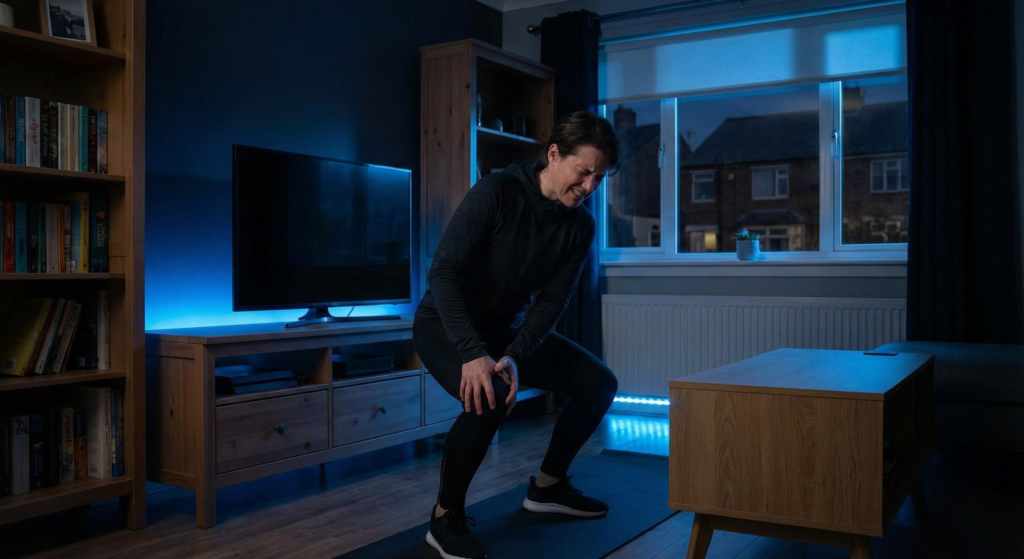
You finish a run or drop into a squat, and there it is again — that dull ache around the front of your knee. It’s not sharp, but it’s enough to make you hesitate on the next rep or cut your run short. That’s the story of patellofemoral pain, often called runner’s knee, and it’s one of the most common issues we see at RX Rehab & Performance in Pacific Beach.
Most people think runner’s knee means something is “wrong” with the kneecap. In reality, the knee is reacting to how the whole leg moves and absorbs force. Once you fix that pattern, pain usually fades fast.
1. What’s Actually Going On in Runner’s Knee
The kneecap sits in a groove on your thigh bone and slides as you bend and straighten the leg. When the surrounding muscles pull unevenly or the joint takes more pressure than it can handle, the tissues around that groove get irritated.
This doesn’t mean the kneecap is “off track.” It means your body is asking for better balance — stronger hips, steadier control, and smoother movement.
2. Why It Happens
Runner’s knee rarely comes from one single event. It builds up when training volume or movement habits outpace your body’s current capacity.
It can start after:
- Increasing your mileage too quickly.
- Spending long hours sitting, which weakens the hips.
- Adding heavy squats or lunges without enough recovery.
We also see this pattern in lifters and surfers around La Jolla, Bird Rock, and Clairemont — anyone who loads the legs repeatedly without balancing strength between the hips, quads, and core.
3. Early Phase: Calming the Pain
When pain first shows up, the goal isn’t total rest — it’s smart movement. Too much rest makes the joint stiffer and the muscles weaker.
Start with shorter sessions or lighter loads. Walking, cycling, or shallow squats are great ways to move without aggravating symptoms. The key is comfort: slight pressure is fine, sharp pain means scale back.
Applying a bit of heat before activity and gentle ice after can also help ease soreness in the early phase.
4. Re-training the Way Your Leg Works
As irritation settles, strength training becomes the most effective treatment. The goal is to spread the work across your hips, thighs, and core so the knee doesn’t take all the force.
We often start patients with controlled movements such as:
- Step-downs — teach the knee to track over the foot instead of caving inward.
- Split squats — build balanced strength between legs.
- Wall sits — simple, low-impact way to fire the quads without joint strain.
For many active adults in Pacific Beach, the turning point comes when they realize the fix isn’t about stretching more — it’s about teaching the body to move better under load.
5. Movement Patterns Matter
During squats or runs, notice where your knees travel. They should line up roughly over your toes. Knees collapsing inward or feet turning out often signal weak hip stabilizers.
Even small technique adjustments can change how your knee feels instantly.
- In the gym, film your form from the front — if the knee drifts inward, push slightly outward as you rise.
- On runs, try a slightly quicker cadence; this reduces the force through each step.
These simple cues can offload the joint and rebuild confidence faster than most people expect.
6. Building Long-Term Resilience
Once pain settles, the focus turns to making your knees bulletproof. That means staying consistent with lower-body strength work and keeping the entire kinetic chain — from hips to ankles — mobile and coordinated.
Add variety to your training: include single-leg work, hip-focused drills, and light plyometrics once the knee feels solid. The goal is not perfection, but capacity — teaching your body to handle the stress you enjoy putting on it.
7. When to Get Professional Help
If pain lingers for more than a few weeks, or it limits daily movement like stairs or sitting, it’s time for a full assessment.
At RX Rehab & Performance, we look at how your hips, ankles, and core interact with your knee. Our treatments combine:
- Manual therapy to calm irritation and improve joint motion.
- Exercise progressions to rebuild strength safely.
- Education so you know exactly what movements to do and why.
Patients from Pacific Beach, La Jolla, and Bay Ho often notice big improvements within a few sessions once we correct load distribution and mechanics.
FAQ
Q1: What is the main cause of runner’s knee?
Usually a mix of weak hips, overuse, and poor movement control that overloads the kneecap.
Q2: Should I stop running if my knee hurts?
Not always. Reducing distance or speed and working on form often lets you keep training safely.
Q3: How long does it take for runner’s knee to heal?
Most people improve in 4–8 weeks with proper loading and strength work.
Q4: Can physical therapy help runner’s knee?
Yes. A program focused on strength and movement control provides long-term relief better than rest or medication.
Q5: Does stretching fix patellofemoral pain?
Stretching can help mobility, but strength and control are what solve the root problem.
Conclusion
Runner’s knee isn’t a knee problem — it’s a movement problem. By strengthening the hips, improving control, and adjusting how you load the leg, you can keep training and running pain-free.
At RX Rehab & Performance, we help you fix the cause, not just the pain, so your knees stay strong, stable, and ready for whatever challenge comes next.
