

You’ve dealt with it before. It went away. You thought you were done with it.
And then it came back.
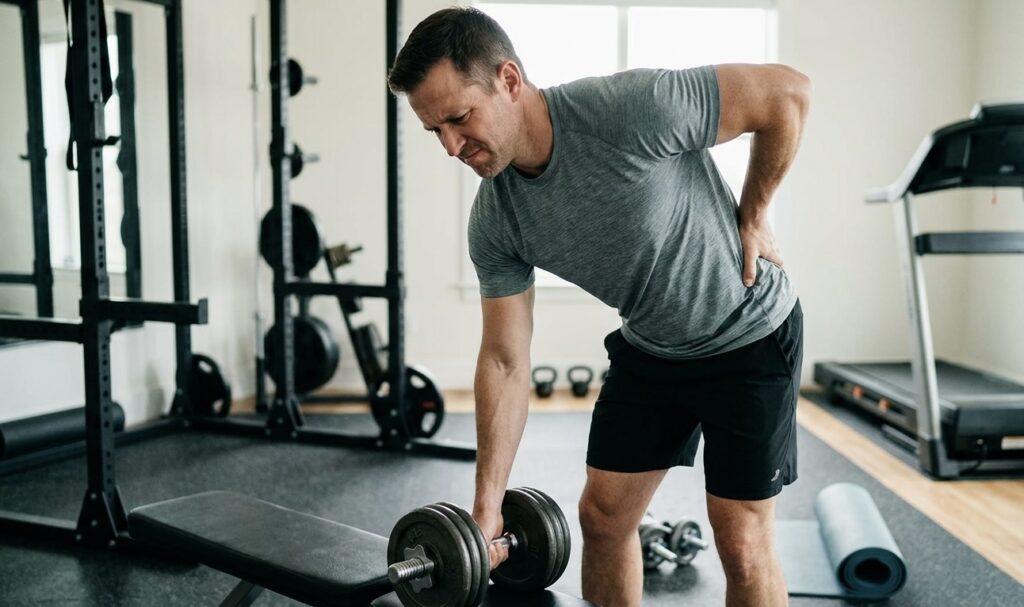
Maybe it came back after a workout. Maybe after a long day at work. Maybe you bent down to pick something up and felt that familiar sensation — the one you thought was behind you — and your stomach dropped a little.
If recurring back pain is a pattern in your life, you’re not alone. Back pain is one of the most common reasons active adults in San Diego visit a provider, take time off from training, and modify their lives around a limitation they were told would resolve.
The problem is this: most back pain treatment is designed to make the pain stop. Not to make it stop coming back.
And there’s a critical difference between those two things.
This article is going to explain exactly why back pain keeps returning, what’s actually happening in your body when it does, and what a real solution — not another round of temporary relief — actually looks like.
Why Treating Pain Is Not the Same as Solving the Problem
When back pain flares up, the instinct is to make it stop. Rest. Anti-inflammatories. A few adjustments. Maybe some stretching. The pain fades, life returns to normal, and you move on.
Until it comes back.
This cycle — flare, treat, resolve, repeat — is one of the most common patterns in musculoskeletal care. And it’s driven by a fundamental misalignment between what most treatment is designed to do and what actually needs to happen to break the cycle permanently.
Most back pain treatment targets the symptom. The pain signal. The inflammation. The tight muscle or the restricted joint. These are real problems and treating them produces real relief. But they are almost never the root cause of why the pain happened in the first place.
The root cause is almost always upstream.
It’s in how you move. In which muscles are doing the work and which ones have opted out. In the compensation patterns your body developed — sometimes years ago, sometimes decades ago — that have been quietly loading your spine unevenly ever since.
Treat the symptom without addressing the root cause, and the root cause keeps doing its job. The same structures keep getting overloaded. The same tissues keep getting irritated. The pain keeps coming back — because nothing changed about the conditions that produced it in the first place.
The Real Reason Back Pain Keeps Returning
To understand why back pain is so prone to recurrence, you need to understand a concept that most patients never hear about: compensatory loading.
Your spine is an extraordinarily capable structure. It’s designed to handle significant load across a wide range of movement. But it’s only designed to handle that load when the surrounding muscles are doing their jobs correctly — stabilizing, distributing force, absorbing impact across the full system.
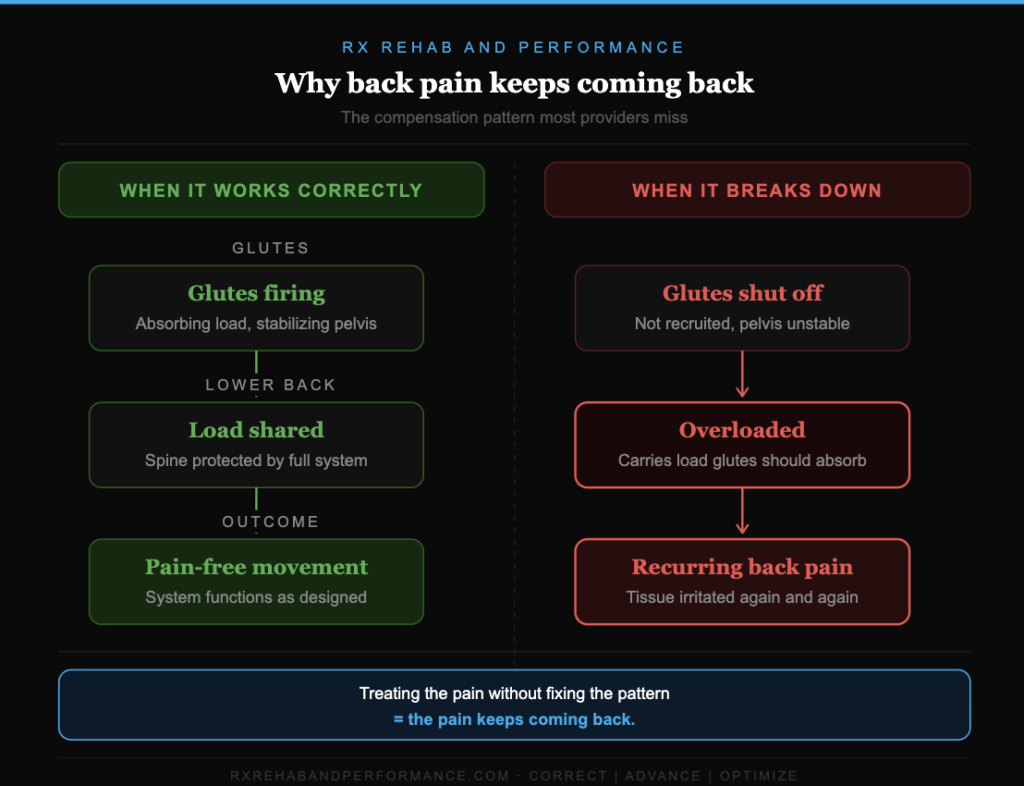
When something goes wrong — an injury, a period of inactivity, a repetitive movement pattern, even prolonged sitting — certain muscles begin to underperform. They don’t fire when they should. They don’t stabilize what they’re supposed to stabilize. And the spine, which is designed to share its load across a full team of muscles, suddenly has to compensate.
Other muscles take over. Movement patterns shift. The body finds a workaround that allows you to keep functioning — but that workaround comes at a cost. Certain structures in the spine now bear load they were never designed to carry alone. Over time, those structures become irritated, inflamed, and eventually painful.
You treat the pain. The irritated structure calms down. The pain goes away.
But the compensation pattern that was overloading that structure in the first place? Still there. Still running. Still loading the same tissues the same way every time you move.
Which is why the pain comes back.
The Most Common Culprits Behind Recurring Back Pain
Understanding that compensation is the driver is one thing. Knowing what to look for is another. Here are the most common movement and structural patterns we see behind recurring back pain in active adults.
Gluteal Inhibition — When Your Glutes Stop Doing Their Job
The gluteal muscles — specifically the gluteus maximus and gluteus medius — are the primary stabilizers of the pelvis and the primary producers of hip extension force. When they’re functioning correctly, they protect the lower back by handling the majority of the load during movements like bending, lifting, squatting, and walking.
When they’re not functioning correctly — which is extraordinarily common in people who sit for extended periods, have a history of hip or back injury, or have developed compensatory movement patterns over time — the lower back picks up the slack. The lumbar extensors, which are not designed to be primary load-bearers for those movements, end up doing the work the glutes should be doing.
The result: chronic overload of the lower back. Pain that feels muscular and diffuse. Tightness that keeps returning no matter how much you stretch. And a pattern that won’t resolve until the glutes are retrained to do their job again.
Core Instability — Stability That Isn’t Actually Stable
“Core strength” is one of the most misunderstood concepts in fitness and rehabilitation. Most people think of the core as the abs — the muscles you see. But the deep stabilizing system of the spine is something entirely different.
The transversus abdominis, the multifidus, the pelvic floor, the diaphragm — these deep muscles create what spine researchers call intra-abdominal pressure: the internal stability that protects the spine during movement. When this system is working correctly, the spine is dynamically stabilized before movement even begins.
When it’s not working correctly — which is common after any back injury, post-pregnancy, or after extended periods of inactivity — the spine is exposed. Every movement, every load, every repetition happens on an unstable foundation. The structures that are supposed to be protected by this internal stability system end up absorbing forces they’re not equipped to handle alone.
The surface-level core muscles compensate. The superficial abs brace harder. The lower back tightens. And what looks like a core strength problem on the outside is actually a coordination and control problem underneath — one that no amount of planks or crunches will fully fix.
Movement Pattern Dysfunction — How You Move Matters as Much as How Much You Move
Beyond specific muscle groups, the overall pattern of how you move through daily life and training is one of the most significant drivers of recurring back pain.
How do you hinge at the hips versus rounding through the lower back? How does your pelvis move when you walk? Are you loading symmetrically, or does one side carry more than its share? Do you extend through your thoracic spine or compensate with lumbar hyperextension?
These patterns develop over time — through injury, through habit, through the adaptations your body made when it was protecting something. And once they’re ingrained, the body uses them automatically. Every rep. Every step. Every time you pick something up.
The tissues that are being overloaded by a dysfunctional movement pattern will continue to be overloaded until the pattern changes. And the pattern won’t change on its own — it has to be identified, addressed, and replaced with deliberate, progressive retraining.
Why “Just Strengthening Your Core” Isn’t Enough
One of the most common pieces of advice given to people with recurring back pain is to strengthen their core. And it’s not wrong — a stronger, better-coordinated core is absolutely part of the solution.
But it’s incomplete. And incomplete solutions produce incomplete results.
Here’s why:
Strengthening a muscle that’s being recruited incorrectly doesn’t fix the recruitment pattern. You can develop a stronger glute and still have a brain-to-muscle communication pattern that doesn’t activate it when it should. You can build a stronger core and still have a deep stability system that doesn’t coordinate properly under load.
Strength training addresses capacity. What recurring back pain almost always requires — in addition to strength — is neuromuscular re-education. Teaching the nervous system to recruit the right muscles at the right time in the right sequence. Rebuilding the motor patterns that were lost or never properly developed. And then loading those patterns progressively until they become automatic.
This is the difference between a rehab program and a gym program. And it’s the difference between treating back pain and solving it.
What a Real Solution Looks Like
If the cycle of recurring back pain is going to be broken — not temporarily managed, but genuinely broken — the approach has to address the full picture.
That means starting with a comprehensive movement assessment that goes beyond where it hurts. We’re not just looking at your back. We’re looking at your hips, your thoracic spine, your pelvis, your ankles — because the back rarely suffers in isolation. The problem is almost always a system problem, and finding it requires looking at the whole system.
From there, a real solution addresses compensation patterns directly. Not just the tight muscles or the restricted joints — the underlying recruitment failures that allowed those compensations to develop. This requires hands-on treatment combined with progressive, specific exercise that retrains the way your body moves.
It also requires progression. A program that addresses your back pain at week one is not the same program you need at week eight. The demands have to evolve as your capacity evolves — increasing load, complexity, and specificity until the movements that used to trigger pain are not just pain-free but genuinely strong.
And finally — critically — it requires closing the gap between pain resolution and performance. The goal is not to get your back to the point where it doesn’t hurt during daily life. The goal is to get it to the point where it can handle everything you want to throw at it — training, sport, travel, life — without coming back.
The Cycle Is Breakable
Recurring back pain feels like an inevitability after you’ve dealt with it long enough. It starts to feel like just the way your body is — something to manage, not something to solve.
It isn’t.
The cycle continues because the root cause continues. Address the root cause — the compensation patterns, the recruitment failures, the movement dysfunction — and the cycle stops. Not because you’re masking the pain better, but because the conditions that kept producing it no longer exist.
That’s what we do at Rx Rehab and Performance in Pacific Beach. We work with active adults across San Diego — from Clairemont and Bay Park to Mission Hills and La Jolla — who are done cycling through temporary relief and ready to find out what’s actually driving the problem.
Not a patch. A solution.
Ready to Find Out What’s Actually Going On?
The first step is a free 20-minute Discovery Call with Dr. Albert personally.
No front desk. No forms. Just a direct conversation about your history, your pattern, and whether we’re the right fit to help you break the cycle for good.
If we are, we’ll bring you in for a complimentary 30-minute Discovery Visit — a comprehensive movement screen where we identify the root cause, not just the symptom.
The pain keeps coming back because something keeps causing it. Let’s find out what that is.
Dr. Albert is the Owner and Head Physician at Rx Rehab and Performance, a rehab and performance clinic located in Pacific Beach, San Diego, CA. Rx Rehab and Performance serves active adults throughout San Diego including Clairemont, Bay Park, Bay Ho, Mission Hills, Mission Valley, La Jolla, Point Loma, Kearny Mesa, and surrounding neighborhoods.
CORRECT | ADVANCE | OPTIMIZE
