

Most people walk into a rehab program with the same mental picture.
Steady progress. Week after week, feeling a little better than the week before. Pain goes down, strength goes up, confidence builds. A clean, upward line moving in the right direction until one day they’re back to normal.
That’s not what real recovery looks like.
And nobody tells you that before you start.
So you go in with the wrong expectations, hit a wall somewhere in the middle, decide the program isn’t working — and quit. Right before everything was about to change.
This happens more than most providers will admit. And it’s one of the most preventable reasons active adults in San Diego never get all the way back.
This article is going to change that. By the end of it, you’ll understand exactly what the real recovery curve looks like, what’s happening in your body during each phase, and why the hard weeks are not a sign that something is wrong — they’re a sign that something is working.
The Myth of Linear Recovery
The idea that recovery should feel like a smooth upward climb is so deeply ingrained that most patients don’t even realize they’re holding onto it. It comes from everywhere — the way providers talk about treatment, the way progress is measured in appointments, the cultural message that if you work hard and do the right things, you’ll see results.
And to be fair, that’s partially true. Hard work and the right program do produce results.
They just don’t produce them on a straight line.
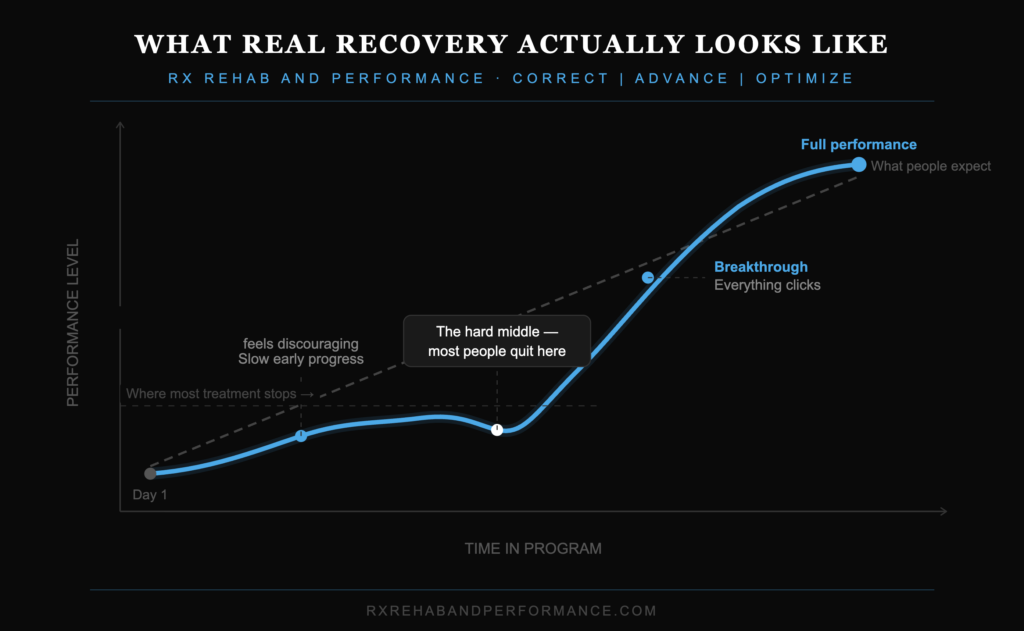
Real recovery is nonlinear by nature. There are phases of rapid early adaptation, phases of plateau where progress seems to stall, and phases of breakthrough where everything consolidates and jumps forward. Understanding those phases — before you’re in them — is the difference between staying in a plan that’s working and abandoning one right before it delivers.
The Three Phases of Real Recovery
Phase 1: The Foundation Phase — Slow Progress, Big Changes Under the Surface
The first few weeks of a recovery program are the most misunderstood.
On the surface, not much seems to be happening. Pain might reduce slightly. Movement might feel a little easier. But the dramatic results most people are expecting haven’t arrived yet — and that gap between expectation and reality is where doubt starts to creep in.
Here’s what’s actually happening underneath:
Your nervous system is learning. Every new movement pattern you practice, every new load you introduce, every session you complete is sending signals to your brain that begin to reorganize how your body recruits muscle, stabilizes joints, and interprets threat. This is called neuromotor adaptation — and it is the foundation of everything that comes after.
Your body is also addressing the compensation patterns that developed around your injury. When you get hurt, your body is remarkably creative at finding workarounds — recruiting different muscles, shifting weight, changing mechanics to protect the painful area. Those patterns became ingrained over time. Unlearning them and rebuilding the right movement patterns takes weeks of consistent work before the results become visible.
This is why early progress feels slow. The real work is happening at a level you can’t feel yet. The foundation is being laid. And if you quit during this phase because it “isn’t working,” you leave before the house gets built.
Phase 2: The Hard Middle — The Phase Most People Quit
This is the most important phase to understand. And it’s the one nobody prepares you for.
Somewhere in the middle of a recovery program — the exact timing varies depending on the injury, the individual, and the program — progress slows. Sometimes it stalls entirely. Sometimes there’s even a week where things feel harder or less comfortable than the week before.
This is called a plateau. And it is completely normal.
Research on rehabilitation across multiple injury types consistently shows that recovery does not follow a smooth trajectory. There are predictable periods of slowing — phases where the body has adapted to its current load and needs a new stimulus to push forward, or where early gains in pain reduction aren’t yet matched by gains in strength and function.
But here’s the problem: nobody explains this to patients beforehand.
So when they hit the hard middle, they interpret it as failure. They think the program isn’t working. They think their body isn’t responding. They get discouraged and either disengage or quit entirely.
The brutal reality? Most people who quit their recovery program quit during the hard middle. Not because their body couldn’t have gotten there. Because they didn’t know that the hard middle was part of the plan.
Here’s what’s actually happening during a plateau:
Your body is consolidating. The adaptations from Phase 1 are being integrated. Neurological changes are solidifying. Tissue is responding to load in ways that don’t show up as immediate pain reduction but are building the foundation for the next jump forward.
Think of it like building strength in the gym. You don’t get stronger during the workout — you get stronger during recovery, when the body adapts to the stimulus you gave it. The plateau phase in rehabilitation is the same mechanism. The body is adapting. It just hasn’t shown its hand yet.
The patients who stay in the hard middle — who trust the process, keep showing up, and keep doing the work — are almost always the ones who break through to Phase 3.
The ones who quit never find out how close they were.
Phase 3: The Breakthrough Phase — When Everything Changes
If Phase 2 is the hardest part of recovery, Phase 3 is the most rewarding.
After the plateau — sometimes suddenly, sometimes gradually — progress accelerates. The things that felt impossible start to feel manageable. The movements that triggered hesitation start to feel automatic. The weight that seemed out of reach goes up. The mile that felt like a fantasy gets run.
This is the breakthrough phase. And it’s what the entire foundation of Phase 1 and the consolidation of Phase 2 were building toward.
Patients often describe this phase as feeling like things “clicked.” And in a very real neurological sense, that’s exactly what happens. The motor patterns that were being learned and reinforced finally consolidate. The nervous system stops treating the previously injured area as a threat. The body integrates everything it’s been taught and begins to perform at a level that reflects the real work that was done.
This is also the phase that gives providers the clearest view of how far a patient has actually come. Because the jump from where they were at the start of Phase 2 to where they are in Phase 3 is often dramatic — even if the progress felt invisible along the way.
Why Most Treatment Stops Too Early
Here’s a critical piece of context: most traditional rehabilitation programs are designed to get you through Phase 1 and into the early stages of Phase 2. Pain is reduced. Basic function is restored. You’re discharged.
That’s a reasonable outcome for someone whose goal is simply to stop hurting.
But for an active adult — someone who wants to run, lift, compete, hike, train, and move without limitation — early Phase 2 discharge is not recovery. It’s halfway.
The gap between “symptoms resolved” and “fully back to performance” is real. It’s the space where most active adults in San Diego get stuck after traditional treatment. They got better — but they didn’t get all the way back. And without a program designed to take them through Phase 2 and into Phase 3, they either plateau indefinitely or regress back toward the start.
This is one of the most common stories we hear from patients who find Rx Rehab and Performance. They did PT. They did chiropractic. They got some relief. But they never got the conversation about what Phase 2 was going to feel like, and when it arrived, they didn’t know whether to push through or pull back. So they pulled back.
And then they found us.
What a Real Return to Performance Actually Requires
Understanding the three phases is the first step. But knowing the curve doesn’t automatically mean you navigate it successfully. That requires a few things that most programs don’t provide.
Honest expectation-setting from the start. Before we begin any program at Rx Rehab and Performance, we have the hard conversation. We tell patients what Phase 2 is going to feel like. We describe the plateau before it arrives. We build it into the plan. That way, when the hard middle comes — and it always comes — it doesn’t catch anyone off guard.
A program that evolves with you. The most common cause of a rehab plateau is a program that stops progressing. When the exercises stay the same week after week, the body adapts to them and stops being challenged. Real recovery requires continuous, intelligent progression — increasing load, complexity, and specificity as the body is ready to handle it.
Addressing the full picture. Pain reduction is not the finish line. A complete return to performance requires restoring strength, rebuilding movement quality, addressing compensation patterns, and reintroducing the specific demands of the activities you want to return to. A program built only around symptom reduction will only get you as far as symptom resolution.
Staying in it through the hard middle. This is the non-negotiable. No provider can do this for you. But the right provider can prepare you for it, support you through it, and adjust the program intelligently when a plateau arrives so that it becomes a launchpad rather than a ceiling.

Where Are You in the Curve?
Take a moment and think honestly about where you are right now.
Are you in Phase 1 — doing the work but not feeling it yet, wondering if anything is happening? That’s exactly where you should be. Stay in it.
Are you in Phase 2 — somewhere in the hard middle, progress has slowed, doubt is creeping in? You are closer than you think. The breakthrough almost always comes right after the moment you almost stopped.
Or are you someone who quit during Phase 2 at some point — who got most of the way there, hit the wall, and backed off? It’s not too late. The curve doesn’t expire.
At Rx Rehab and Performance in Pacific Beach, we work exclusively with active adults in San Diego — from Clairemont to La Jolla, Mission Valley to Point Loma — who are ready to understand their recovery, trust the process, and get all the way back. Not halfway. All the way.
Ready to Understand Your Recovery?
The first step is a conversation.
We offer a complimentary Discovery Call with Dr. Albert personally — a free 20-minute call where we talk about where you are in your recovery, what you’ve already tried, and what a real plan back to full performance could look like for you.
If it’s a great fit, we’ll bring you in for a complimentary 30-minute Discovery Visit — a real movement screen where we identify root causes and start building the map from where you are to where you want to go.
No generic protocols. No programs that stop when your pain does. Just a plan built around the full curve — and the support to get you through every phase of it.
Dr. Albert is the Owner and Head Physician at Rx Rehab and Performance, a rehab and performance clinic located in Pacific Beach, San Diego, CA. Rx Rehab and Performance serves active adults throughout San Diego including Clairemont, La Jolla, Mission Valley, Point Loma, Mission Hills, Bay Park, and surrounding neighborhoods.
CORRECT | ADVANCE | OPTIMIZE
