

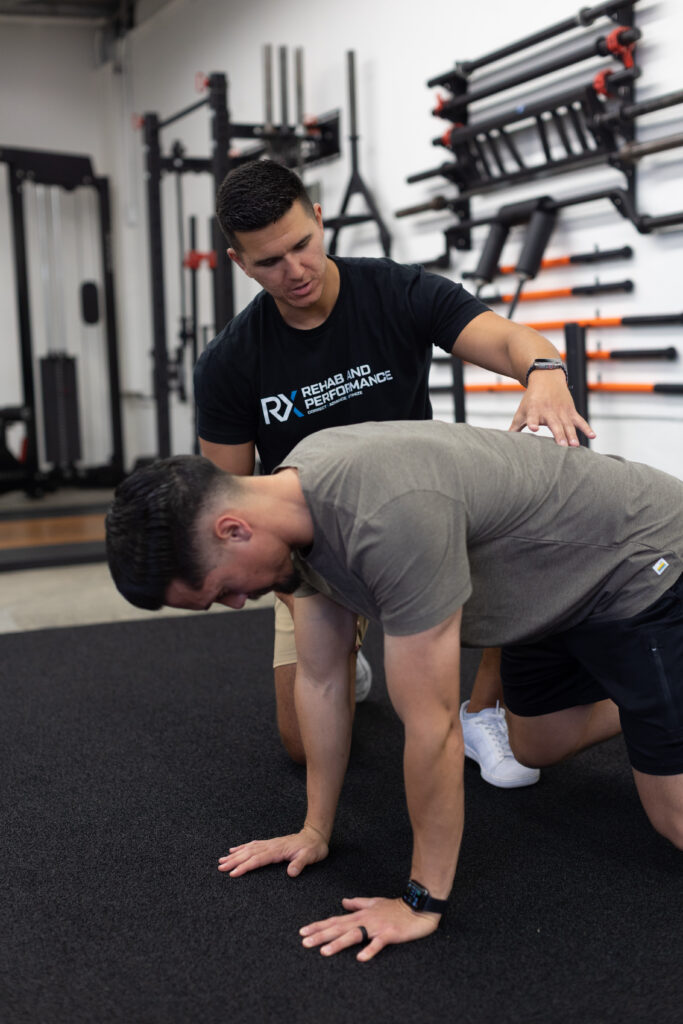
Most people come to us expecting to be put on a table.
They’ve been through the system before. They know the drill — fill out the intake paperwork, describe where it hurts, get assessed, get treated. In and out. See you next week.
So when they sit down across from me in their first session and I start asking them about their Saturday mornings, their training goals, the trip they’ve been putting off, or the sport they quietly stopped signing up for — they look at me a little sideways.
“I thought we were here to talk about my knee.”
We are. But your knee doesn’t exist in a vacuum. It exists inside your life. And if we don’t understand your life, we can’t build a plan that actually gets you back to it.
This is the philosophy behind every new patient intake at Rx Rehab and Performance. Before we run a single assessment, before we identify a single compensation pattern, before we touch anything — we ask questions. Real ones. And we listen carefully to the answers.
Here’s exactly what we ask, why we ask it, and why the answers change everything about the outcome.
Why Most Rehab Stops Short
To understand why our intake process is built the way it is, it helps to understand where most rehabilitation falls short.
Traditional rehab is designed around a problem. You come in with a diagnosis — a torn meniscus, a herniated disc, a sprained ankle — and the program is built around resolving that diagnosis. Reduce pain. Restore range of motion. Strengthen the surrounding muscles. Discharge.
That model works for what it’s designed to do. But it has a fundamental limitation: it treats the injury, not the person.
For someone who just wants to get through daily life without pain, that’s often enough. But for an active adult — someone who trains, competes, hikes, lifts, runs, plays with their kids, or simply refuses to accept that their best physical years are behind them — “resolved” is not the same as “back.”
There is a gap between the end of traditional rehabilitation and a full return to the performance life you want to live. That gap is where compensation patterns live. Where fear-avoidance cycles develop. Where people spend months — sometimes years — working around their injury instead of through it.
At Rx Rehab and Performance, we don’t start at the injury. We start at the goal. And that changes the entire trajectory of care from day one.
The Questions We Ask — And What They’re Really Doing
“What do you want to get back to — specifically?”
This is always the first real question. And we push past the first answer.
Most people start with something general: “I want to get back to the gym” or “I want to be able to run again.” Those are starting points, not destinations. We keep going.
What does getting back to the gym look like for you? What movements, what weights, what does a good training session feel like? When you say you want to run again — are we talking a few miles on a flat path, or are we talking a trail half marathon you’ve been eyeing for two years?
The specificity matters enormously. A plan built around “return to running” looks completely different from a plan built around “complete a 10-mile trail race with 2,000 feet of elevation gain by October.” The loading, the progression, the benchmarks, the timeline — everything changes when the goal is specific.
Vague goals produce vague outcomes. Specific goals produce specific plans that produce specific results.
“What does your life look like when your body isn’t the obstacle?”
This question does something different. It shifts the conversation from the injury to the identity.
Most patients who come to us have been managing their limitation for long enough that they’ve started to reorganize their life around it. They’ve stopped signing up for things. They’ve declined invitations. They’ve quietly adjusted what they let themselves want because wanting something they can’t have is painful in its own way.
This question gives them permission to want it again.
It also gives us critical information. Because the answer to “what does your life look like when your body isn’t the obstacle” is almost always more specific and more emotionally charged than the answer to “what’s your goal.” It reveals what’s actually at stake — not just physically, but personally.
That emotional connection to the outcome is not soft. It’s strategic. Patients who are connected to a meaningful, specific goal tolerate the hard weeks better. They show up consistently. They push through the uncomfortable progressions because they know exactly what they’re working toward.
The goal has to matter. Our job is to find out what matters.

“What have you already tried — and what happened?”
This question is about more than history. It’s about pattern recognition.
By the time most patients find Rx Rehab and Performance, they’ve already been somewhere else. Sometimes several somewheres. And the history of what they tried, how they responded, where they got relief, and where they hit a ceiling tells us an enormous amount about what’s actually going on.
We’re listening for a few things specifically:
What improved and what didn’t. If pain improved but function didn’t, that tells us the tissue healed but the movement patterns were never addressed. If function improved temporarily but symptoms returned every time they tried to load, that tells us the progression wasn’t matched to the demand.
What they were told versus what they experienced. There’s often a gap between “the PT said I was fine” and “I still couldn’t do the thing I came in to do.” That gap is where we work.
What they stopped doing and why. The activities a patient has given up are often more revealing than the ones they’ve kept. Avoidance is information. It tells us where the fear is, where the distrust lives, and what we need to build back progressively.
Every previous treatment experience — even the ones that didn’t work — gives us data. We use all of it.
“On a scale of one to ten, how much do you trust your body right now?”
This is the question that usually catches people off guard.
It’s not a clinical measure. There’s no right answer. But the response tells us something that no imaging study or orthopedic assessment can capture: where the patient’s relationship with their own body actually stands.
Someone who scores a two has a very different psychological starting point than someone who scores a seven — even if their objective physical findings are identical. The person at a two needs more time in the early stages of the program building confidence through easy wins before we can layer on load. The person at a seven is ready to move faster and can tolerate more discomfort in the process.
Pain neuroscience research is clear on this: the brain’s perception of threat is as relevant to recovery as the physical state of the tissue. A patient who fundamentally doesn’t trust their body will guard, compensate, and limit — no matter how well their structural healing has progressed.
We design programs around both dimensions. Physical capacity and psychological readiness. You cannot have a complete return to performance without addressing both.
“What does success look like at the end of this program?”
We ask this last — after everything else — because by this point the patient has usually gotten more specific than they were at the start of the conversation.
And the answer to this question becomes the benchmark we hold ourselves to.
Not “patient reports reduced pain.” Not “improved range of motion.” Those are markers along the way, not the destination.
Success for Kourtney was pushing over 300 pounds on the sled, running miles, and jumping the way she did in college. Success for someone else might be hiking the Appalachian Trail, getting back to recreational soccer, or simply picking up their grandchildren without fear.
We write it down. We refer back to it. And we build every week of the program in its direction.
When a patient finishes with us and tells us we got them exactly where they wanted to go — that’s not an accident. It’s the result of knowing from day one exactly where that was.
Why This Process Produces Different Outcomes
The questions we ask aren’t formalities. They’re the foundation of everything that follows.
Here’s what changes when you start with goals instead of symptoms:
The plan has a direction. Every exercise, every progression, every decision in the program connects back to a specific destination. Nothing is generic. Nothing is filler. Every week moves the needle toward something the patient actually cares about.
The patient is a partner, not a passenger. When someone understands why they’re doing what they’re doing — and how it connects to the life they want back — they engage differently. They’re invested. They show up. They push.
The outcome is measurable. “Less pain” is hard to measure and easy to plateau. “Running five miles without hesitation” is concrete. You either get there or you don’t — and if you’re not tracking toward it, we adjust.
The gap gets closed. Not partially. Fully. The space between symptom resolution and true return to performance is exactly what this intake process is designed to bridge — because it identifies from the very first session what “the other side” looks like for this specific person.

What This Looks Like for You
If you’ve read this far, there’s a good chance something here resonated.
Maybe you’ve been through rehab before and felt like the plan was built around your diagnosis rather than your life. Maybe you got some relief but never made it all the way back. Maybe you’ve quietly adjusted your goals downward and told yourself that’s just what getting older looks like.
It doesn’t have to be.
The questions we ask in our intake process aren’t complicated. But they change everything about what comes after. And the answers you give — your specific goals, your specific life, your specific definition of what getting back to 100% looks like — become the blueprint for a program built entirely around you.
That’s what outcome-based rehabilitation looks like when it’s done right.
Start With a Conversation
The first step at Rx Rehab and Performance is always a Discovery Call — a free 15-minute conversation with Dr. Albert personally.
No front desk. No intake forms. Just a direct conversation about where you are, where you want to go, and whether we’re the right fit to get you there.
If we are, we’ll bring you in for a complimentary 30-minute Discovery Visit — a real movement screen where we start identifying root causes, not just symptoms.
If we’re not the right fit, we’ll tell you honestly and point you toward someone who is.
The questions start on that first call. And the answers you give will shape everything that follows.
Dr. Albert is the Owner and Head Physician at Rx Rehab and Performance, a rehab and performance clinic serving active adults. Rx Rehab and Performance specializes in bridging the gap between injury recovery and return to full performance.
