

You got hurt. You went through the process — rest, maybe some physical therapy, some time off from the things you love. Eventually the pain faded. You were told you were cleared.
So why does it still feel like something is off?
Why do you still hesitate before squatting heavy? Why does a certain movement make you hold your breath before you do it? Why have you quietly restructured your training — or your life — around an injury that’s technically healed?
If any of that sounds familiar, there’s a good chance you’re caught inside what’s called the fear-avoidance cycle. And the frustrating part is that most people who are stuck in it have no idea it exists.
This article is going to change that.
Your Body Healed. Your Brain Didn’t Get the Memo.
Here’s something most people — including most healthcare providers — don’t talk about enough after an injury:
Your body and your brain heal on different timelines.
When you get hurt, your nervous system does exactly what it’s designed to do. It ramps up sensitivity in the injured area. It makes you guard it, protect it, and move differently to avoid loading it. It turns the alarm system all the way up.
That’s not a flaw. That’s your body protecting you. In the short term, it’s one of the most important survival mechanisms you have.
The problem is that sometimes — especially after significant injuries, repeated injuries, or injuries that weren’t properly rehabilitated — that alarm system doesn’t turn back off when it should.
The tissue heals. The structural damage resolves. Scans come back clean. But your brain has already written a new rule into its operating system: this movement is dangerous. And it holds onto that rule long after the physical reason for it is gone.
This is the foundation of what pain scientists call the fear-avoidance cycle — and it’s one of the most common and least-addressed reasons active adults stay stuck after injury.
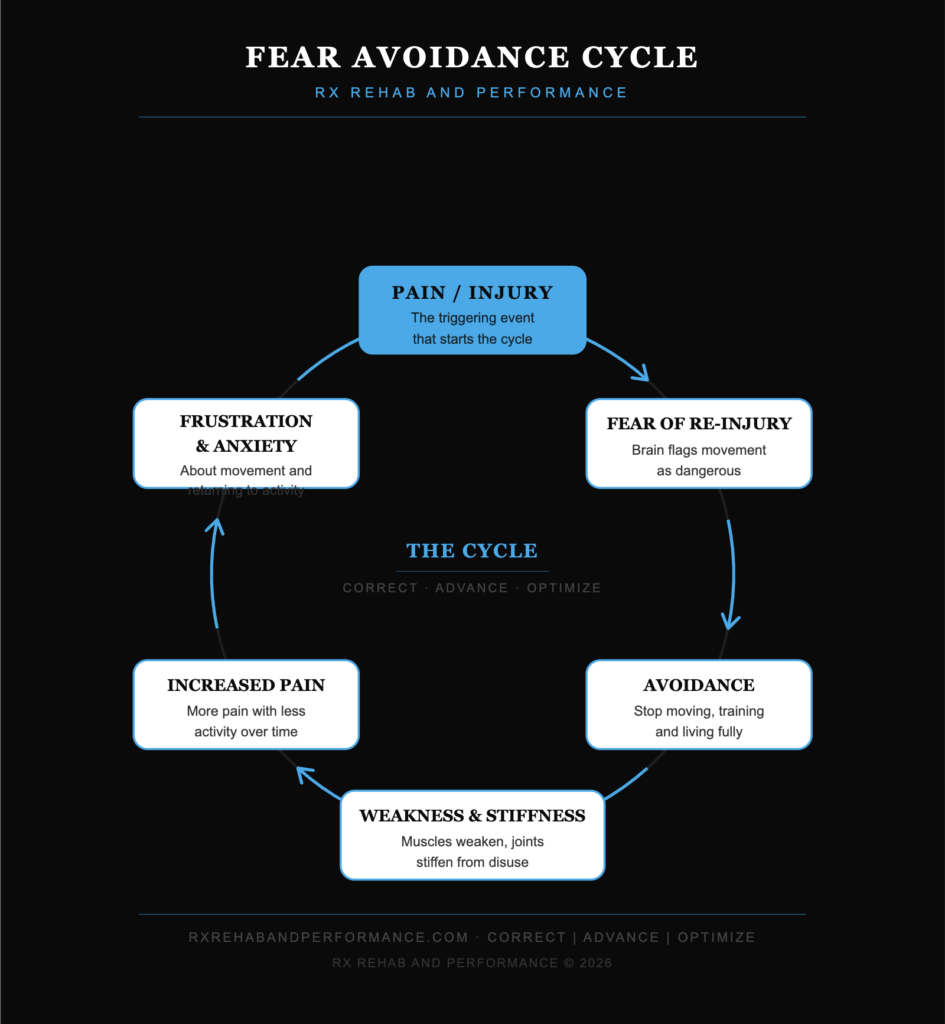
What Is the Fear-Avoidance Cycle?
The fear-avoidance cycle is a well-documented pattern in pain science research that describes how the psychological response to pain can perpetuate physical limitation — even after the original injury has healed.
It works like this:
Injury occurs → Pain signals threat → Movement feels dangerous → Avoidance begins → The area weakens and stiffens → The next attempt at movement feels worse → The brain confirms its belief that movement is dangerous → Avoidance deepens
And then it repeats.
Every loop reinforces the last one. Every time you skip the loaded squat, avoid the trail run, or modify around the movement that scared you — without being taught why it’s safe to return — your nervous system collects more evidence that the avoidance was the right call.
Over time, this doesn’t just affect how you train. It affects how you move through your daily life. It affects which routes you walk. Which activities you plan for. Which physical goals you quietly stop letting yourself want.
The injury becomes a lens through which everything gets filtered — and most people don’t even realize it’s happening.
The Gap Between “Cleared” and “Back”
One of the most important things to understand about the fear-avoidance cycle is that it can develop even when your medical care was excellent.
You can have a skilled surgeon. A competent physical therapist. A thorough recovery plan. You can follow every instruction, hit every milestone, and be formally cleared to return to activity — and still be deeply stuck inside this cycle.
Why? Because most rehabilitation programs are designed to resolve symptoms. To get you out of pain. To restore baseline function.
What they’re rarely designed to do is bridge the gap between “no longer hurting” and “fully back to doing what you love.”
That gap is real. It’s where the fear-avoidance cycle lives. And it’s where so many active adults spend months — sometimes years — without anyone ever naming what’s happening or giving them a plan to move through it.
3 Signs You Might Be Caught in the Fear-Avoidance Cycle
You don’t need a formal diagnosis to recognize this pattern in yourself. Here are three of the most common signs that the fear-avoidance cycle is still running the show — even if your injury happened months or years ago.
1. You move differently than you used to — and nobody ever taught you why or how to fix it.
After an injury, the body develops compensation patterns. You shift weight to the uninjured side. You change your squat mechanics. You stop fully loading a joint. You recruit different muscles to protect the area that got hurt.
In the short term, this is smart and adaptive. In the long term — especially if it was never addressed — it becomes a new movement baseline that puts you at higher risk for future injury and keeps the original area weak and underloaded.
If you’ve noticed that you just “move differently now” without a clear understanding of why or a clear plan to address it, that’s a sign the rehabilitation process didn’t go all the way.
2. There’s a split-second hesitation before movements that used to be automatic.
Think about the movements that gave you confidence before your injury. Jumping. Sprinting. Cutting. Squatting under load. A specific lift or skill in your sport.
Now think about how you approach those movements today. Is there a moment of “should I?” before you do them? A brief scan of your body, a breath you hold, a mental check-in that wasn’t there before?
That hesitation is your nervous system doing its job — protecting an area it still believes is at risk. It doesn’t mean you’re weak or overcautious. It means your brain is operating from an outdated rule, and nobody has given it new evidence yet.
3. You’ve built your training around your injury instead of through it.
This one is subtle but important. Ask yourself: have you changed your exercise selection, lowered your weights, avoided certain positions, or restructured your goals to accommodate an injury — without ever being given a progressive plan to return to the original thing?
That’s the fear-avoidance cycle at work. Not dramatically. Not catastrophically. Just quietly reshaping what you allow yourself to do — and over time, reshaping who you believe yourself to be as an athlete and active adult.
The Good News: This Is Reversible
The fear-avoidance cycle is not a permanent state. It is a learned pattern, and learned patterns can be unlearned — with the right approach.
What breaks the cycle isn’t rest. It isn’t more time. And it usually isn’t another passive treatment that keeps you on a table while someone else does something to your body.
What breaks the cycle is progressive, intentional, guided loading — combined with a clear understanding of why each step is safe.
When you load an injured area progressively, with intention and clinical oversight, you are doing something specific: you are giving your nervous system new evidence. You are showing your brain — through reps, through experience, through actual movement — that the thing it classified as dangerous is safe.
Over enough reps, over enough sessions, the brain updates its rules. The alarm system recalibrates. The hesitation fades. And the movement that once felt threatening starts to feel like yours again.
This is what a true return to performance looks like. Not symptom resolution. Not being cleared and left to figure out the rest on your own. A deliberate, progressive process that closes the gap between where you are and where you actually want to be.
What This Looks Like in Practice at RXRP
At RXRP — Rehab and Performance, this is the gap we exist to close.
We work exclusively with active adults — people who are not looking to simply manage their pain, but to return fully to the sports, activities, and physical pursuits that define how they live their lives.
Before we develop any plan of care, we spend real time understanding where you want to go. Not just “less pain.” Specifically — what does your life look like when your body isn’t the obstacle? What’s the first thing you’d do if the limitation were gone? What does getting back to 100% actually mean to you?
Those questions aren’t small talk. They shape every decision we make in your program.
From there, we build a progressive, outcome-based plan designed to systematically rebuild your confidence and capacity — not just in the injured area, but in your body as a whole system. We address the compensations. We reload the avoided movements. We give your nervous system the evidence it needs to stop sounding the alarm.
Because you shouldn’t have to build your life around your injury. You should be able to build it around your goals.
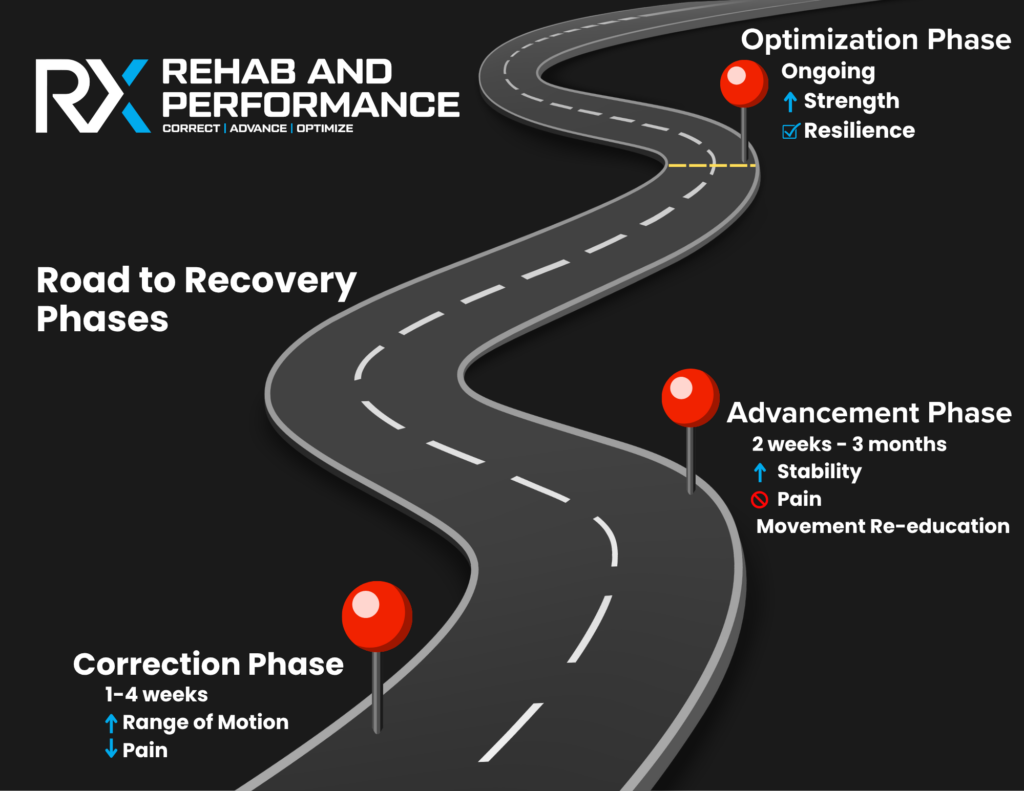
Ready to Find Out What’s Actually Going On?
If anything in this article resonated — if you recognize the hesitation, the compensation patterns, the quiet adjustments you’ve made without a plan to undo them — the first step is a conversation.
We offer a complimentary Discovery Call with Dr. Albert personally. It’s a free 15-minute call where we learn about your situation, your goals, and whether RXRP is the right fit for where you want to go.
No pressure. No commitment. Just clarity.
Dr. Albert is the Owner and Head Physician at Rx Rehab and Performance, a rehab and performance clinic serving active adults in San Diego. RXRP specializes in bridging the gap between injury recovery and return to full performance.
CORRECT | ADVANCE | OPTIMIZE
