

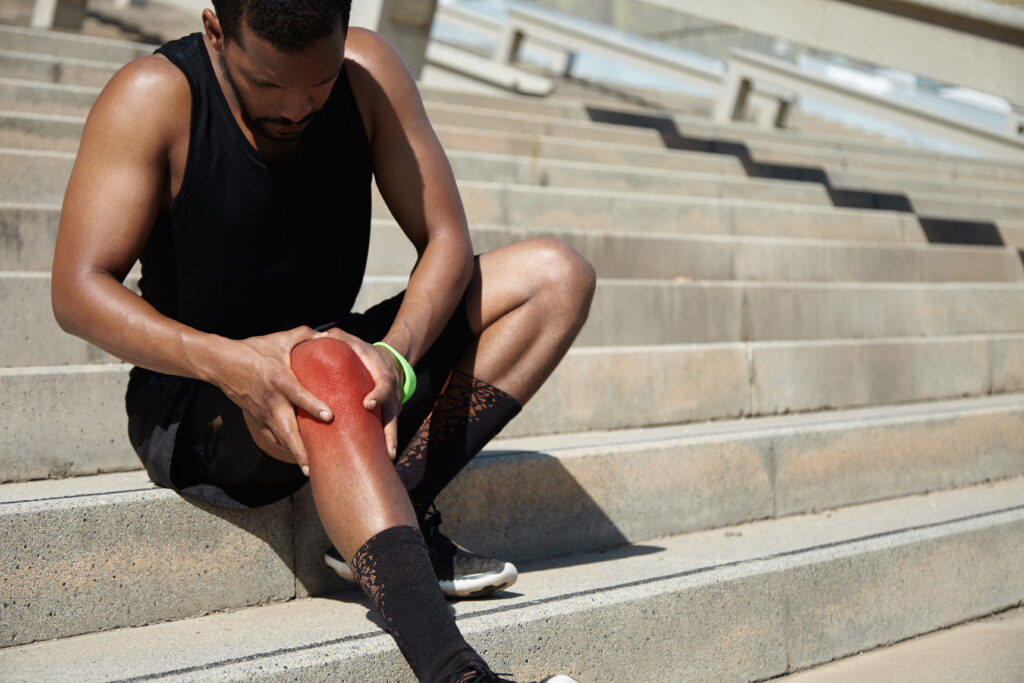
You’re halfway through your run when a sharp ache hits the outside of your knee. You stop, stretch your leg, maybe roll it out — but next run, it’s back.
That’s the frustration of IT band pain, one of the most common overuse issues we treat at RX Rehab & Performance in Pacific Beach.
Most runners think they need to “loosen” the IT band. But here’s the truth — the IT band isn’t tight, it’s doing too much work. The fix isn’t stretching harder; it’s balancing strength and movement so the knee tracks smoothly again.
1. What the IT Band Actually Does
The iliotibial band is a strong band of tissue that runs from your hip to your shin. It stabilizes the leg when you run, especially during single-leg stance.
Because it doesn’t contract like a muscle, it can’t really be “stretched” — though tightness in the surrounding tissues can make it feel that way.
When the glutes or hip stabilizers get weak, the IT band picks up the slack — and eventually becomes irritated where it rubs near the knee.
2. Why IT Band Pain Happens
The pain isn’t from the IT band itself being damaged — it’s from friction and overload along the outside of the knee.
Common triggers include:
- Sudden increases in running distance or downhill miles
- Weak glute medius and hip rotators
- Over-striding or running on sloped surfaces
- Excessive foam rolling directly on the IT band (irritates it further)
This condition often shows up in active runners around La Jolla, Pacific Beach, and Clairemont, especially those who’ve upped mileage or returned to training after time off.
3. Why Stretching Doesn’t Fix It
Here’s what most people get wrong: the IT band is not a muscle. It’s a thick, fibrous structure that doesn’t lengthen easily. Stretching it might feel good for a minute, but it won’t change the underlying problem.
The real solution is improving how your hip and knee share load — so the IT band doesn’t have to compensate.
4. What to Strengthen Instead
At RX Rehab & Performance, we help runners retrain movement through progressive strength work that targets stability and control.
Key Focus Areas:
- Glute Medius: Builds hip stability to reduce knee stress.
- Exercise: Side-lying leg raises or band walks.
- Glute Max: Powers hip extension and supports control through push-off.
- Exercise: Hip thrusts or bridges.
- Core Stability: Keeps the pelvis level when the foot strikes.
- Exercise: Dead bugs or side planks.
Even a few weeks of targeted strength training can drastically reduce knee irritation and improve running efficiency.
5. What to Avoid During Recovery
- Aggressive Foam Rolling: Light massage around the hip and quad is fine — avoid grinding the IT band itself.
- Excessive Downhill Running: Increases strain on the lateral knee.
- Complete Rest: Light movement and strength work promote faster recovery than total inactivity.
6. Smart Return-to-Run Strategy
Once pain improves, reintroduce running with structure:
- Start with shorter, flat runs.
- Use a run-walk approach for the first few sessions.
- Add speed or hills gradually — 10% increases per week at most.
Your goal isn’t just to get back to running, but to run stronger than before.
7. How We Treat IT Band Pain at RX Rehab & Performance
Our treatment combines manual therapy, strength programming, and movement coaching tailored to each runner’s pattern.
We focus on:
- Releasing tight tissues around the hip and thigh.
- Correcting movement control so the knee tracks properly.
- Building durable strength through glutes, core, and foot muscles.
- Educating runners on load management and form efficiency.
Runners from Pacific Beach, La Jolla, and Bird Rock often notice a major difference within 3–4 visits when this approach is followed consistently.
8. Long-Term Prevention Tips
- Strength train 2–3× per week, even during race season.
- Mix flat, trail, and hill runs for balanced load.
- Replace worn-out shoes every 300–400 miles.
- Keep mobility in the hips and ankles, not just the IT band.
Healthy hips make for happy knees — and pain-free running.
FAQ
Q1: What causes IT band pain while running?
Weak hips and overuse irritate the tissue near the knee, not the band itself.
Q2: Should I stretch or foam roll my IT band?
Light rolling around the hip and thigh is fine, but don’t overdo it — strengthening is more effective.
Q3: How long does IT band pain take to heal?
Most runners improve in 4–8 weeks with proper strength and load management.
Q4: Can I keep running with IT band pain?
Yes, if pain is mild. Reduce distance and intensity until symptoms calm down.
Q5: Can physical therapy help IT band syndrome?
Absolutely. Manual therapy and targeted exercise fix the root cause faster than stretching alone.
Conclusion
IT band pain isn’t a sign you’re broken — it’s feedback.
Your body’s asking for better balance, stronger hips, and smarter loading. Once that’s restored, you can run freely again.
At RX Rehab & Performance, we help runners across Pacific Beach and La Jolla stay strong, confident, and pain-free with personalized rehab and movement coaching built for real-world results.
